
Wallengrenia egeremet
(Scudder, 1863)
northern broken dash
A small (Hesperiidae) native to eastern and central North America. fly in summer, with single or double depending on latitude. Larvae feed on Panicum grasses; adults visit flowers for nectar. Taxonomic placement remains uncertain, with some sources placing it in Polites or treating it as with Wallengrenia otho.

Pronunciation
How to pronounce Wallengrenia egeremet: /ˌwɔːlɛnˈɡriːniə ˈɛɡərɛmɛt/
These audio files are automatically generated. While they are not always 100% accurate, they are a good starting point.
Identification
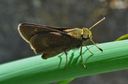
The dark dash on the forewing gives this its and separates it from the southern broken dash (Wallengrenia otho), with which it may be confused. The two species overlap in range and are difficult to distinguish without close examination; genitalia dissection or molecular analysis may be required for certain identification where ranges overlap.
Images
Habitat
Open grassy areas, wet meadows, marshes, and edges of woodlands. Associated with supporting Panicum grasses.
Distribution
Eastern and central North America: southern Maine and southern Ontario west to southeastern North Dakota, south to central Florida, Gulf Coast, and southeastern Texas. Records confirmed from Manitoba, Vermont, and throughout core range.
Seasonality
active June–August in single across most of range. Two generations occur May–October in Deep South and eastern Texas.
Diet
Larvae feed on Panicum clandestinum, Panicum dichotomum, and other Panicum . feed on nectar of white, pink, or purple flowers including dogbane (Apocynum), red clover (Trifolium pratense), New Jersey tea (Ceanothus americanus), and sweet pepperbush (Clethra alnifolia).
Host Associations
- Panicum clandestinum - larval food plant
- Panicum dichotomum - larval food plant
- Panicum - larval food plant various
- Apocynum - nectar sourcedogbane
- Trifolium pratense - nectar sourcered clover
- Ceanothus americanus - nectar sourceNew Jersey tea
- Clethra alnifolia - nectar sourcesweet pepperbush
Life Cycle
Complete with , larva, pupa, and stages. Larvae feed on grasses; occurs in shelter of folded leaves or debris. One or two per year depending on latitude.
Behavior
Rapid, darting typical of skippers. perch on vegetation and sally out to investigate intruders or potential mates. Males establish territories in open grassy areas.
Ecological Role
Larvae are herbivores on Panicum grasses. serve as of various flowering plants. Provides food source for including birds and other .
Human Relevance
No significant economic impact. Occasionally observed by enthusiasts. Used as for grassland quality in some regions.
Similar Taxa
- Wallengrenia othoSouthern broken dash; extremely similar in appearance, may be . Separated primarily by range and subtle wing pattern differences, though identification uncertain without examination of genitalia or .
- Polites speciesSome authorities place W. egeremet in Polites; if so, would be similar to other Polites skippers such as P. peckius and P. mystic, requiring genitalia examination for separation.
Misconceptions
The has been treated as a of Wallengrenia otho by some authors, and placed in Polites by others (e.g., NatureServe). Current consensus remains unsettled, and specimens from zone of potential overlap with W. otho may be misidentified in museum collections and citizen science databases.
More Details
Taxonomic Uncertainty
Generic placement disputed between Wallengrenia and Polites. boundaries with W. otho unclear; may represent a single variable species or distinct but cryptic species. Molecular phylogenetic studies needed to resolve status.