
Wallengrenia otho
(Smith, 1797)
southern broken dash, broken dash skipper
Wallengrenia otho is a small in the Hesperiidae, distributed across the Americas from the southeastern United States through Central America to Argentina. The exhibits multivoltine patterns in temperate regions and year-round activity in tropical areas. Larvae develop on grasses in the Paspalum and Stenotaphrum, while feed on nectar from wetland and riparian flowers.
Pronunciation
How to pronounce Wallengrenia otho: /wəˌlɛnˈɡriːniə ˈoʊθoʊ/
These audio files are automatically generated. While they are not always 100% accurate, they are a good starting point.
Identification
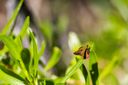
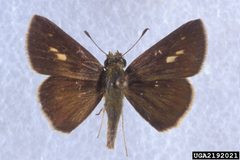
Distinguished from similar Wallengrenia and other grass skippers by the broken or irregular dash on the hindwing undersurface. The species is smaller than many co-occurring skipper species. In the southeastern United States, it may be confused with Wallengrenia egeremet (northern broken dash), with which it has historically been considered ; the two are now generally treated as separate species, though some uncertainty remains regarding their taxonomic relationship. Accurate identification may require examination of genitalia in some cases.
Images
Habitat
Occupies open, sunny including grasslands, meadows, marshes, and edges of wetlands. Associated with areas supporting larval grasses, particularly in moist or seasonally wet conditions. In tropical regions, found in a variety of open habitats from sea level to moderate elevations.
Distribution
Native to the Americas. In North America, occurs from eastern Texas and the southeastern United States (Georgia, Florida, Carolinas) north to stray records in central Missouri, northern Kentucky, and Delaware. Range extends south through the West Indies and Central America to Argentina. have been described from various Caribbean islands and mainland regions.
Seasonality
In most of North America, are active from April to October in two , with a partial third generation possible in favorable conditions. In peninsular Florida and southern Texas, adults fly year-round without distinct seasonal interruption.
Diet
Larvae feed on grasses in the Paspalum and Stenotaphrum secundatum (St. Augustine grass). feed on nectar from flowers including Pontederia cordata (pickerelweed), Prunella vulgaris (selfheal), and Clethra alnifolia (sweet pepperbush).
Host Associations
- Paspalum - larval Multiple
- Stenotaphrum secundatum - larval St. Augustine grass
- Pontederia cordata - nectar sourcePickerelweed
- Prunella vulgaris - nectar sourceSelfheal
- Clethra alnifolia - nectar sourceSweet pepperbush
Life Cycle
Complete with , larva, pupa, and stages. In temperate regions, two to three per year; continuous breeding in tropical regions. Larvae develop on grasses, with occurring in sheltered locations. stage not explicitly documented in available sources.
Behavior
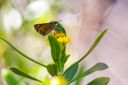
are rapid, darting fliers typical of skippers, often remaining close to the ground in grassy areas. Males perch on low vegetation to await females. Both sexes visit flowers for nectar, with adults frequently observed at wetland flowers.
Ecological Role
function as of their nectar plants. Larvae are herbivores that consume grasses, with no significant documented impact on native ; one , Stenotaphrum secundatum, is widely used as a turfgrass. The serves as prey for various including birds, spiders, and predatory insects.
Human Relevance
Not considered an agricultural pest. Occasionally encountered in gardens and urban areas where grasses are present. Of minor interest to watchers and naturalists. No documented economic importance.
Similar Taxa
- Wallengrenia egeremetHistorically considered or a ; now generally treated as separate (northern broken dash). Geographic separation and subtle morphological differences distinguish the two, though some taxonomic uncertainty persists.
- Other Hesperiinae skippersSimilar small size and brown/orange coloration; distinguished by broken dash marking on hindwing and specific wing pattern elements.
More Details
Taxonomic uncertainty
The relationship between Wallengrenia otho and W. egeremet remains somewhat unresolved, with some sources treating the latter as a of the former. Multiple subspecies of W. otho have been described from Caribbean islands and South America, including W. o. otho, W. o. drury, W. o. , W. o. misera, W. o. ophites, W. o. vesuria, and W. o. sapuca.