
Polites vibex
(Geyer, 1832)
whirlabout
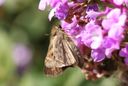
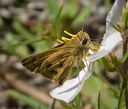
Polites vibex, commonly known as the whirlabout, is a grass skipper in the Hesperiidae. The derives from the 's distinctive pattern—a circular, vortex-like motion during landing and takeoff. The exhibits strong in coloration, with males being orange and yellow while females are dark brown. It is resident throughout the southeastern United States, West Indies, Mexico, and tropical regions of Central and South America to Argentina, with seasonal northward during warmer months.

Pronunciation
How to pronounce Polites vibex: /ˈpɒlɪtiːz ˈvaɪbɛks/
These audio files are automatically generated. While they are not always 100% accurate, they are a good starting point.
Identification
Males are readily distinguished from similar skippers by the combination of orange and yellow coloration with the dark four-sided patch near the stigma. Females are darker brown with contrasting light spots. The whirlabout pattern—circular, whirling motion during landing and takeoff—is diagnostic when observed. Separation from other Polites requires examination of wing pattern details, particularly the arrangement and shape of spots and bands.
Images
Habitat
Coastal plain grassy areas, fields, dunes, pinewoods, roadsides, disturbed areas, vacant lots, open woodlots, forest edges, parks, lawns, and gardens. Associated with open, sunny supporting grasses.
Distribution
Resident from the southeastern United States and West Indies to eastern Mexico, through the tropics to Argentina. Seasonally extends northward during warmer months to Ohio, Connecticut, and northeast Iowa in North America. Present throughout the Caribbean, Middle America, North America, and South America.
Seasonality
Flies year-round north of the equator. Migrates northward in late summer and fall in North America.
Diet
Larvae feed on various grasses, primarily at night. consume nectar from flowers.
Host Associations
- various grasses - larval food plantspecific grass not documented in sources
Life Cycle
are white and laid singly on plants. Larvae feed nocturnally on grasses. Specific details of and stage not documented in available sources.
Behavior
exhibit a distinctive whirling, circular pattern during landing and takeoff, which gives the its . Larvae feed primarily at night.
Ecological Role
function as through nectar feeding. Larvae are herbivores on grasses. Specific ecological interactions not documented.
Human Relevance
Subject to general decline trends. No specific economic or cultural significance documented. Not known to be of conservation concern relative to other , though affected by loss and use affecting grassland butterflies generally.
Similar Taxa
- Polites sabuletiSandhill skipper, also a grass skipper with similar preferences; distinguished by wing pattern and geographic range
- Polites sonoraSonora skipper, similar member with different geographic distribution and wing markings
More Details
Sexual dimorphism
The shows pronounced in coloration, with males brightly colored (orange/yellow) and females dark brown, despite similar size.
Migration
Northward in late summer and fall allows temporary range extension into northern states, but permanent residency is limited to southeastern U.S. and southward.
Sources and further reading
- BugGuide
- Wikipedia
- GBIF taxonomy match
- NCBI Taxonomy
- Catalogue of Life
- Where Are All the Butterflies? | Bug Squad
- Polites -sonora - Entomology Today
- The best species name ever! | Beetles In The Bush
- Very wary tigers! | Beetles In The Bush
- How Climate Change is Affecting Insect Biodiversity
- A Look at the Science of Insect Conservation