
Polites sabuleti
(Boisduval, 1852)
Sandhill Skipper, Saltgrass Skipper
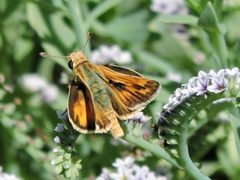
Polites sabuleti is a small grassland in the Hesperiidae, native to western North America from southern British Columbia to Baja California and east to the Rocky Mountains. It has been introduced to Hawaii. The is notable for its association with weedy grasses including Bermuda grass (Cynodon dactylon), and has experienced significant declines in parts of its range, particularly in California's Sierra Valley.
Pronunciation
How to pronounce Polites sabuleti: /pəˈlaɪtiːz sæbjuˈleɪtaɪ/
These audio files are automatically generated. While they are not always 100% accurate, they are a good starting point.
Identification
Distinguished from similar Polites by association and geographic range. The species' reliance on Bermuda grass and other low-growing grasses in open, often alkaline or sandy habitats may aid identification. Multiple described (at least 12) showing geographic variation across its range, though subspecies identification requires detailed examination.
Images
Appearance
Small with wingspan of 22–32 mm. Typical skipper with robust body, large , and with hooked clubs. Wing coloration and pattern details not specified in available sources.
Habitat
Grassland , particularly those with alkaline soils or sandy conditions. Associated with open areas supporting grasses including Bermuda grass, Kentucky bluegrass, and saltgrass. Found from sea level to high elevations, with elevational range varying by region.
Distribution
Native to western North America: southern British Columbia and eastern Washington south through California and northern Arizona to Baja California; east to southeastern Wyoming, central Colorado, and northeastern New Mexico. Introduced and established in Hawaii.
Seasonality
Single at high elevations with active June to August. Multiple generations (March to October) in southern parts of range and at low elevations. Timing varies with latitude and elevation.
Diet
Larvae feed on various grasses including Cynodon dactylon (Bermuda grass), Poa pratensis (Kentucky bluegrass), Distichlis spicata var. stricta (saltgrass), Eragrostis trichodes, Agrostis scabra, Festuca idahoensis, and Festuca brachyphylla. feed on flower nectar.
Host Associations
- Cynodon dactylon - larval Bermuda grass
- Poa pratensis - larval Kentucky bluegrass
- Distichlis spicata var. stricta - larval Saltgrass
- Eragrostis trichodes - larval
- Agrostis scabra - larval
- Festuca idahoensis - larval
- Festuca brachyphylla - larval
Life Cycle
Complete with , larva, pupa, and stages. Larvae feed on grasses; likely occurs in or near plants. Number of per year varies by location and elevation: at high elevations, multivoltine at low elevations and in southern range.
Behavior
are active during daylight hours. period and number of determined by and temperature cues, with facultative likely influenced by environmental conditions.
Ecological Role
Herbivore in grassland . Larvae consume grasses, potentially contributing to nutrient cycling. may serve as when nectaring. Serves as an for grassland health; declines have been documented in long-term monitoring studies.
Human Relevance
Subject of long-term monitoring by researchers including Art Shapiro's transect studies in California. Documented population declines have contributed to understanding broader population trends and climate change impacts. Not a significant agricultural pest despite feeding on common lawn grasses.
Similar Taxa
- Other Polites speciesSimilar and preferences; distinguished by geographic range, associations, and subtle morphological differences
- Other Hesperiinae skippersShared grassland and grass-feeding larvae; identification requires examination of wing pattern, size, and genitalia
More Details
Population Decline
Documented in precipitous decline at Sierra Valley, California monitoring site by Art Shapiro's research group, despite breeding on ubiquitous Bermuda grass. Decline attributed to climate change factors including warming temperatures and disruption of cues.
Subspecies Diversity
At least 12 described, reflecting geographic variation across western North America: P. s. sabuleti, P. s. tecumseh, P. s. chusca, P. s. margaretae, P. s. ministigma, P. s. alkaliensis, P. s. albamontana, P. s. sinemaculata, P. s. nigrescens, P. s. basinensis, P. s. aestivalis, and P. s. channelensis.
Hawaiian Introduction
Established as non-native in Hawaii, representing a successful human-mediated range expansion outside native distribution.
Sources and further reading
- BugGuide
- Wikipedia
- GBIF taxonomy match
- iNaturalist taxon
- NCBI Taxonomy
- Catalogue of Life
- Where Are All the Butterflies? | Bug Squad
- Polites -sonora - Entomology Today
- Myrmica sabuleti Archives - Entomology Today
- The Curious Case of the Large Blue Butterfly -- a Conservation Success Story
- The best species name ever! | Beetles In The Bush
- How Climate Change is Affecting Insect Biodiversity