
Panoquina ocola
(Edwards, 1863)
Ocola Skipper, long-winged skipper
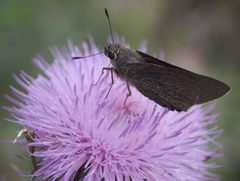
Panoquina ocola is a with an exceptionally long forewing relative to its body, giving it a distinctive elongated silhouette. It ranges from Paraguay through tropical America and the West Indies to the southern United States, with occasional strays reaching as far north as Canada. The is strongly associated with cultivated grasses and has been documented feeding on rice, sugarcane, and related wetland grasses.
Pronunciation
How to pronounce Panoquina ocola: /pænəˈkwɪnə oʊˈkoʊlə/
These audio files are automatically generated. While they are not always 100% accurate, they are a good starting point.
Identification
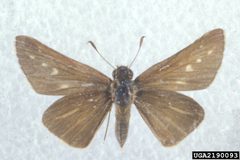
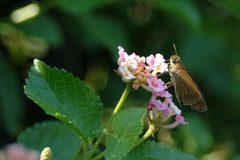
The extremely elongated forewings separate this from all other North American skippers. Most similar species in Panoquina (P. panoquin, P. hecebolus) have proportionally shorter, broader forewings. The ocola skipper's resting posture, with forewings held at a steep angle and hindwings flat, accentuates the wing length difference. Dark coloration and small pale spots are shared with but wing proportions are diagnostic.
Images
Appearance
Wingspan 35–43 mm. Forewings notably elongated and narrow, extending well beyond the hindwings when at rest, creating a 'long-winged' appearance. Upper surface dark brown with small pale spots; underside of hindwing often shows a purplish or grayish sheen. Body relatively slender for a skipper. with hooked tips typical of Hesperiidae.
Habitat
Wetland edges, rice fields, sugarcane plantations, and moist grassy areas. Strongly associated with cultivated and wild grasses in humid lowlands. Often found in disturbed agricultural and along drainage ditches where grasses grow.
Distribution
Resident from Paraguay north through tropical South America, Central America, and the West Indies to southern Texas and Florida. Strays documented north to southeast Arizona, Kansas, Illinois, Michigan, southern Ontario, New York, and Long Island. Two recognized: P. o. ocola (widespread mainland form) and P. o. distipuncta (Dominican Republic).
Seasonality
Multiple in southern range; present year-round in tropical areas. In the United States, most common late summer through fall (August–November) when southern disperse northward. Strays in northern latitudes typically recorded September–October.
Diet
Larvae feed on Oryza sativa (rice), Saccharum officinarum (sugarcane), and Hymenachne amplexicaulis (a wetland grass). food sources not documented in sources.
Host Associations
- Oryza sativa - larval cultivated rice
- Saccharum officinarum - larval sugarcane
- Hymenachne amplexicaulis - larval West Indian marsh grass
Life Cycle
Complete with , larva, pupa, and stages. Specific details of development time, stage, and number of per year not documented in sources. Multiple inferred from extended period in subtropical regions.
Behavior
Rapid, darting typical of skippers. often perch with wings partially open, forewings raised at steep angle. Strong capability evidenced by regular northward straying hundreds of kilometers beyond resident range. or activity patterns not documented.
Ecological Role
Larval herbivore on grasses; potential minor pest of rice and sugarcane . Role in native poorly documented. pollination services, if any, not recorded.
Human Relevance
Occasional pest of rice and sugarcane in tropical regions. Attracted to agricultural landscapes; strays occasionally observed in urban and suburban areas far from resident range. Not a significant economic pest in the United States.
Similar Taxa
- Panoquina panoquinSimilar dark coloration and preference, but has proportionally shorter, broader forewings and more extensive pale spotting on hindwing underside.
- Panoquina hecebolusOverlapping range in southern United States; distinguished by shorter forewings and different wing spot pattern.
More Details
Subspecies
P. o. ocola (nominate): Florida to Ohio, Mexico to Brazil, Argentina, Venezuela to Peru, Suriname. P. o. distipuncta Johnson & Matusik, 1988: Dominican Republic, distinguished by differences in wing spotting.