
Sympistis anweileri
Troubridge & Lafontaine, 2008
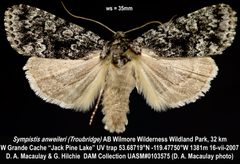
Sympistis anweileri is a noctuid described from western North America in 2008. It occurs at moderate to high elevations (2,000–8,000 feet) in mountainous terrain from Alberta and British Columbia south to Montana. The inhabits a range of from alpine treeline to dry valley forests. fly in mid-summer with a wingspan of 30–36 mm.
Pronunciation
How to pronounce Sympistis anweileri: //sɪmˈpɪs.tɪs ænˈwaɪ.lɛɹi//
These audio files are automatically generated. While they are not always 100% accurate, they are a good starting point.
Identification
The can be distinguished from other Sympistis by its known western montane distribution and period (mid-July to late August). Accurate identification requires examination of genitalia or reference to the original species description (Troubridge & Lafontaine 2008).
Images
Appearance
Wingspan 30–36 mm. Specific coloration and pattern details not documented in available sources.
Habitat
Mountainous areas from treeline to valley elevations, including dry coniferous forests. Occurs across a broad altitudinal range (2,000–8,000 feet), suggesting adaptability to varied montane conditions.
Distribution
Western North America: Alberta and British Columbia (Canada) south to Montana (USA). Records indicate presence rather than abundance; the appears restricted to the northern Rocky Mountains and adjacent ranges.
Seasonality
active mid-July to late August. Single inferred from narrow window.
Similar Taxa
- Sympistis speciesNumerous occur in western North America; many require dissection for reliable identification. S. anweileri is distinguished by combination of geography, elevation, and , though genitalic examination is necessary for confirmation.
More Details
Taxonomic history
Described by Canadian lepidopterists James T. Troubridge and J. Donald Lafontaine in 2008, reflecting ongoing discovery and documentation of North American noctuid diversity. The specific epithet honors an individual (likely a collector or colleague), though the etymology is not explicitly stated in sources.
Collection and observation status
iNaturalist records (26 observations as of source date) suggest the is documented but not frequently encountered, consistent with its montane and relatively recent description.