
Calophasia lunula
Hufnagel, 1766
Toadflax Brocade Moth, Toadflax Moth
Calophasia lunula is a noctuid native to the Palearctic region, introduced to North America as a agent for toadflax . The moth's larvae are specialized feeders on yellow toadflax (Linaria vulgaris) and Dalmatian toadflax (Linaria genistifolia ssp. dalmatica), causing significant defoliation that reduces seed production. feed on nectar without causing plant damage. The species has established in parts of Canada and the United States following intentional introductions beginning in the early 1960s.
Pronunciation
How to pronounce Calophasia lunula: /kæloʊˈfeɪziə luːˈnjuːlə/
These audio files are automatically generated. While they are not always 100% accurate, they are a good starting point.
Identification
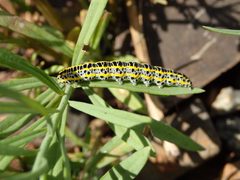
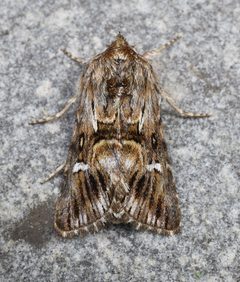
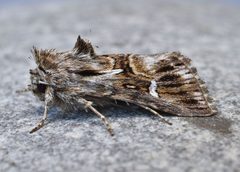
distinguished from similar noctuids by combination of bluish-grey forewing ground color with olive fuscous suffusion, conspicuous white stigma with black lateral edges, and chequered fringe. Larvae readily identified by black and white spotted pattern with bright yellow stripes, unlike most other noctuid larvae on toadflax. May be confused with other Calophasia in Europe; genitalia examination required for definitive identification.
Images
Habitat
Native range: warm slopes, heathlands, and wastelands, particularly in areas with toadflax plants. In introduced North American range: open including rangelands, roadsides, and disturbed areas where toadflax occurs. In the Alps, found at elevations up to 2000 meters. Cold, rainy springs appear to limit establishment success.
Distribution
Native: throughout Europe including Central and Southern Europe, east through Russia and Central Asia to the Russian Far East; absent from Japan. Introduced: parts of Canada and the United States, where established in many areas but with limited success in colder climates.
Seasonality
active during warmer months; precise timing varies by latitude. In North America, and activity correlated with spring temperatures, with delayed appearances following cold, rainy springs. Larval feeding period approximately one month. occurs as pupae.
Diet
Larvae feed exclusively on toadflax (Linaria), specifically yellow toadflax (Linaria vulgaris) and Dalmatian toadflax (Linaria genistifolia ssp. dalmatica). Larvae consume leaf and flower buds initially, then stems, leaves, and flowers, often causing complete defoliation. feed on nectar from plants without causing damage.
Host Associations
- Linaria vulgaris - larval food plantyellow toadflax; primary target for in North America
- Linaria genistifolia ssp. dalmatica - larval food plantDalmatian toadflax; secondary target for
Life Cycle
Female lays 30-80 on leaves and flowers of plants. Eggs hatch in 1-2 weeks. Larva undergoes five over approximately one month. Mature larva pupates in cocoon of chewed plant matter and leaf litter, in this stage. emerge in spring; single per year in most of range.
Behavior
Larvae are voracious feeders, consuming new growth first before moving to older tissue. Defoliation can be extensive but does not necessarily kill plants; primary impact is reduction in seed production and propagation. do not contribute to plant damage.
Ecological Role
herbivore on toadflax . In native range, natural control of toadflax. In introduced North American range, acts as agent reducing competitive ability and spread of toadflax weeds. Part of supporting and of noctuid larvae.
Human Relevance
Primary significance is as agent against toadflax weeds in North America. First introduced to Canada in early 1960s, then to United States. Reduces toadflax seed production and vegetative spread, though complete plant mortality is uncommon. Used in integrated weed management programs. No known negative economic or ecological impacts from introduction.
Similar Taxa
- Other Calophasia speciesSimilar wing patterns; require genitalia dissection for definitive identification
- Generalist noctuid larvae on toadflaxLarvae may occur on same plants; distinguished by C. lunula's distinctive black-white-yellow spotted pattern
More Details
Biological Control History
Introduced to Canada in early 1960s and United States shortly thereafter as agent. Establishment success varies regionally; persist and spread in warmer climates but struggle in colder areas with prolonged cold or wet spring conditions.
Impact Assessment
While larval feeding can cause dramatic defoliation, plant mortality is rare. Primary mechanism of weed suppression is reduction in seed output and competitive vigor, making toadflax more susceptible to other control measures or competitive displacement by native vegetation.