
Lithomoia germana
(Morrison, 1875)
American Brindle, American Brindle Moth
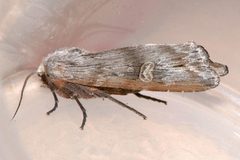
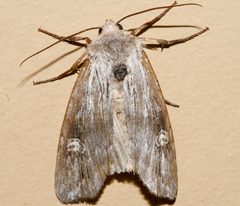
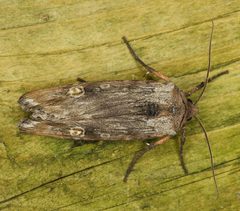
Lithomoia germana, commonly known as the American Brindle, is a noctuid with a broad distribution across northern North America. are , active in spring and again in late summer to early autumn. The is notable for hibernating as an adult, an strategy that allows early spring . Larvae feed on woody plants in Salicaceae and Betulaceae, while adults visit goldenrod flowers for nectar.
Pronunciation
How to pronounce Lithomoia germana: /lɪθəˈmoɪə dʒɛrˈmeɪnə/
These audio files are automatically generated. While they are not always 100% accurate, they are a good starting point.
Identification
The brindled forewing pattern with irregular dark transverse lines and a mix of brown, gray, and black tones distinguishes this from many similar noctuids. The combination of early spring period (April-May) and late summer/autumn second (August-October) helps separate it from relatives. The overall appearance resembles bark, making it difficult to spot at rest. Examination of genitalia may be required for definitive identification from closely related Xylena and Lithomoia species.
Images
Appearance
have a wingspan of approximately 40 mm. The forewings display a complex brindled pattern of brown, gray, and black markings that provide cryptic camouflage against bark. The hindwings are typically paler, often dull grayish or brownish with subtle venation visible. The body is robust and densely scaled, with a furry . Overall coloration is highly variable but consistently features intricate mottling that blends with tree bark textures.
Habitat
Associated with forested and wooded , particularly where plants in Salicaceae (willows, poplars) and Betulaceae (birches, alders) occur. Found in and temperate deciduous and mixed woodlands, as well as riparian corridors with dense shrub growth. are often found resting on tree trunks during daylight hours.
Distribution
Transcontinental in northern North America. Range extends from Alaska across Canada to Newfoundland, southward through the northern United States to Pennsylvania in the east, Colorado in the central region, and Oregon in the west. The Lithomoia germana morrisoni occurs in Alaska, and L. g. albertae in Alberta.
Seasonality
with two distinct periods. First active from mid-April to early May; second generation from mid-August to early October. The extended period between generations reflects adult hibernation through summer.
Diet
Larvae feed on leaves of various trees and woody shrubs, specifically documented from Salicaceae and Betulaceae. feed on nectar, with goldenrod (Solidago) flowers specifically recorded as a nectar source.
Host Associations
- Salicaceae - larval food plant includes willows and poplars
- Betulaceae - larval food plant includes birches and alders
- Solidago - nectar sourcegoldenrod flowers
Life Cycle
Complete with , larva, pupa, and stages. The exhibits adult hibernation (), with mature adults to emerge in spring. This results in a pattern where the spring reproduces, larvae develop through summer, and a second adult generation emerges in late summer. These late-season adults then hibernate to complete the cycle.
Behavior
are and attracted to light. They hibernate as adults, seeking sheltered locations such as under bark, in leaf litter, or in other protected microsites during winter months. Daytime resting posture involves pressing flat against tree bark to exploit cryptic coloration. Adults have been observed feeding on goldenrod nectar during their active periods.
Ecological Role
Larvae function as folivores on woody shrubs and trees, contributing to nutrient cycling and serving as prey for and . serve as when visiting flowers for nectar. The represents part of the diverse noctuid fauna supporting higher in and temperate forest .
Human Relevance
Occasional specimen in entomological collections. Not an agricultural or forestry pest. may be encountered at porch lights in rural and suburban areas within their range. Of interest to lepidopterists studying strategies and seasonal patterns.
Similar Taxa
- Xylena speciesClosely related and formerly classified within Xylena; share similar size, wing shape, and cryptic bark-matching coloration. May require genital dissection or detailed wing pattern analysis for separation.
- Other Lithomoia speciesCongeneric share overall and traits; geographic range and subtle wing pattern differences are primary distinguishing features.
- Other Noctuinae with brindled forewingsMany noctuids exhibit similar bark-matching coloration; timing (especially the early spring ) and specific pattern elements help distinguish L. germana.
More Details
Taxonomic History
Previously classified under the Xylena as Xylena germana. Currently treated as a distinct genus Lithomoia by most modern authorities, though some sources still list it as a synonym of Xylena. The basionym dates to Morrison (1874 or 1875 depending on source). Three are recognized, distinguished primarily by geographic distribution.
Overwintering Strategy
hibernation is relatively uncommon among Noctuidae, where most overwinter as , larvae, or pupae. This strategy allows immediate upon spring without the time investment required for larval development, potentially advantageous in short growing seasons at northern latitudes.