
Eupsilia
Hübner, 1821
Species Guides
8- Eupsilia cirripalea(Franclemont's Sallow)
- Eupsilia devia(Lost Sallow)
- Eupsilia fringata
- Eupsilia morrisoni(Morrison's Sallow)
- Eupsilia schweitzeri(Schweitzer's Sallow)
- Eupsilia sidus(Barrens Sallow)
- Eupsilia tristigmata(Three-spotted Sallow)
- Eupsilia vinulenta(Straight-toothed Sallow)
Eupsilia is a of medium-sized owlet moths (Noctuidae) established by Hübner in 1821. The genus contains approximately 25 described distributed across the Holarctic, with the best-known species being Eupsilia transversa (the Satellite), named for the distinctive small dot adjacent to the stigma on each forewing. Taxonomic placement remains unresolved, with sources placing it in either Noctuinae (tribe Xylenini, subtribe Xylenina) or Hadeninae. Members of this genus are autumn-emerging that overwinter as .
Pronunciation
How to pronounce Eupsilia: /juːpˈsɪliə/
These audio files are automatically generated. While they are not always 100% accurate, they are a good starting point.
Identification
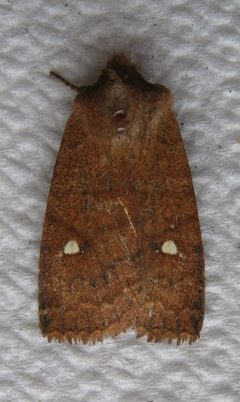
Eupsilia are distinguished by the presence of a small 'satellite' dot adjacent to the stigma on the forewing, a trait most prominent in E. transversa. The ground coloration is typically red-brown with considerable intraspecific variation. The reniform stigma is white to orange. are medium-sized for noctuids. Species-level identification within the requires examination of genitalia or other subtle morphological characters.
Images
Habitat
Occupies varied including woodlands, hedgerows, and scrub. Larvae occur on diverse trees and shrubs. are attracted to light traps and 'sugar' (fermenting sweet solutions applied to tree trunks and fence posts).
Distribution
Holarctic distribution. Present throughout Eurasia; in Britain widespread and common, in Ireland widespread but more localized. North American records include the northeastern United States (Vermont) and Canada. GBIF records document presence in Denmark, Norway, and Sweden.
Seasonality
with autumn . appear from late September through October, overwinter, and remain active on mild nights until late April. Larval stage occurs April through July.
Diet
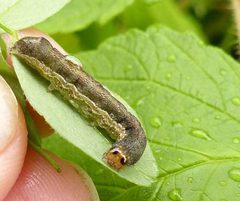
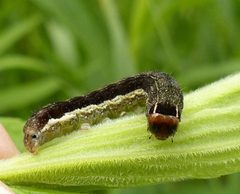
Larvae are , feeding on a wide range of trees and shrubs; larger larvae have been observed to consume other larvae and aphids. feed on ivy blossom, birch sap, sallow, and berries including Guelder-rose.
Life Cycle
One per year. laid in autumn; larvae present April-July, feeding nocturnally and hiding in spun leaves by day. occurs in a cocoon formed on the ground. emerge late September/October, overwinter, and fly on mild nights through late April.
Behavior
are more frequently encountered at 'sugar' than at light traps. Larvae are feeders that construct daytime shelters by spinning leaves together.
Human Relevance
Eupsilia transversa is a well-studied used as a model for genomic research, with a published sequence. are regular visitors to traps and sugar baits, making them familiar to lepidopterists.
Similar Taxa
- Other Noctuinae/Xylenini generaSimilar medium-sized noctuid and autumn/winter activity pattern, but distinguished by the diagnostic satellite dot on the forewing in Eupsilia
More Details
Taxonomic uncertainty
The placement of Eupsilia remains disputed. BugGuide.net places it in Noctuinae, tribe Xylenini, subtribe Xylenina, while Biolib places it in Hadeninae. Catalogue of Life accepts Noctuinae > Xylenini > Xylenina.
Genomic resources
The of Eupsilia transversa has been sequenced and published (Wellcome Open Research, PMCID: PMC11316177), providing genetic resources for this .