
Eupsilia schweitzeri
Lavitt & Wagner, 2016
Schweitzer's Sallow
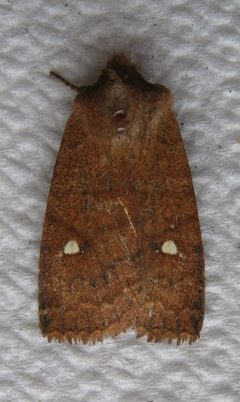
Eupsilia schweitzeri is a in the Noctuidae, described in 2016 from the northeastern United States. It belongs to the sallow moth Eupsilia, which are medium-sized noctuid moths active during late fall, winter, and early spring. The species was named in honor of entomologist Dale F. Schweitzer. Like other members of its genus, it is likely a cold-season active with larvae feeding on woody plants.
Pronunciation
How to pronounce Eupsilia schweitzeri: /juːpˈsɪliə ʃvaɪtsˈɛri/
These audio files are automatically generated. While they are not always 100% accurate, they are a good starting point.
Identification
Externally nearly identical to Eupsilia vinulenta and E. morrisoni; reliable separation requires examination of male genitalia. The valvae of E. schweitzeri males have a distinctive shape with a more rounded cucullus and reduced cornutus compared to E. vinulenta. Female identification relies on subtle differences in the signum of the corpus bursae. Geographic origin provides supporting evidence, as E. schweitzeri occurs in areas where E. vinulenta is absent or rare.
Images
Habitat
Deciduous and mixed forests of the northeastern United States, particularly in areas with rich hardwood understories. Associated with mature forest stands containing oak, maple, and birch. Elevational range extends from lowland river valleys to lower montane slopes.
Distribution
to the northeastern United States. Documented from Pennsylvania, New Jersey, New York, and New England. The range appears to overlap broadly with E. vinulenta in some areas but extends into regions where that is scarce or absent, particularly in more northerly and interior portions of New England.
Seasonality
are active during late fall through early spring, with peak activity in late winter. This winter-active pattern is characteristic of the Eupsilia. Adults have been recorded from November through March, with most observations in January–February.
Behavior
are and come to light. Like other Eupsilia , adults are among the few regularly active during freezing conditions, with activity triggered by temperature increases rather than . Adults likely feed on tree sap, rotting fruit, and possibly honeydew, though this has not been documented specifically for this species.
Similar Taxa
- Eupsilia vinulentaNearly identical forewing pattern and coloration; distinguished by male genitalia structure and geographic distribution
- Eupsilia morrisoniSimilar size and general appearance; E. morrisoni typically has more contrasting forewing markings and different male genitalia
- Eupsilia sidusOverlapping range in some areas; E. sidus has more distinctly patterned forewings with a clearer spot
More Details
Taxonomic history
Described in 2016 by Lavitt and Wagner based on specimens previously misidentified as Eupsilia vinulenta. The represents a cryptic lineage distinguished through morphological and molecular analysis. The specific epithet honors Dale F. Schweitzer for his contributions to North American Lepidoptera conservation and .
Conservation status
Not formally assessed; appears to be locally common within its limited range but potentially vulnerable to forest fragmentation and climate change given its specialized requirements and winter-active .