
Aseptis pseudolichena
Mustelin & Leuschner, 2000
Aseptis pseudolichena is a noctuid to southern California, first described in 2000. It occupies open pine-oak forest, foothill chaparral, and grassy scrub across six counties. are active from June to August and have been documented in only two iNaturalist observations, suggesting limited survey effort or naturally restricted abundance.
Pronunciation
How to pronounce Aseptis pseudolichena: /æˈsɛptɪs ˌsuːdoʊlaɪˈkiːnə/
These audio files are automatically generated. While they are not always 100% accurate, they are a good starting point.
Identification
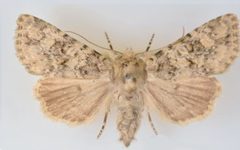
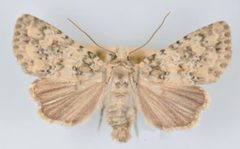
Distinguished from the similar Aseptis lichena by more yellowish overall coloration due to mixture of pale tan or yellowish with scattered darker scales; A. lichena lacks this yellowish cast. Combination of serrate antemedial and postmedial lines, white and black dots on to postmedial line, and large black-outlined spot filled with dark scales further supports identification. Specimens range from very pale yellow to olive tan, so color alone is not diagnostic without comparison to reference material.
Images
Appearance
Medium-sized noctuid with wingspan 30.5–36 mm. Forewing ground color ranges from very pale yellow through pale tan to olive tan, created by mixture of pale tan or yellowish with scattered tan, olive, and black scales. Antemedial and postmedial lines are serrate; postmedial line followed by white and black dots on . Pale subterminal line usually visible. spot round, filled with ground color. spot large, outlined in black, filled with dark scales. Faint pale postreniform patch present.
Habitat
Open pine and oak forest, open areas with grass and scrub, and foothill chaparral. Occupies mid-elevation foothill zones with mixed woody and herbaceous vegetation.
Distribution
to southern California. Documented from San Diego, Riverside, Los Angeles, Ventura, San Bernardino, and Tuolumne counties.
Seasonality
on wing from June to August. Single period coincides with summer dry season in Mediterranean climate zone.
Diet
Larvae feed on Ribes malvaceum (chaparral currant). feeding habits unknown.
Host Associations
- Ribes malvaceum - larval Larvae have been reared from this plant
Life Cycle
Complete with documented larval stage feeding on Ribes malvaceum. Specific details of , pupal, and longevity not described. Presumed given restricted June–August adult period.
Ecological Role
Larval herbivore on native shrub Ribes malvaceum; specific ecological functions (pollination, , ) undocumented.
Human Relevance
No documented economic or cultural significance. Limited scientific attention due to recent description and restricted range.
Similar Taxa
- Aseptis lichenaOverlaps in range and general ; distinguished by less yellowish coloration and absence of pale tan/yellowish mixture
More Details
Taxonomic history
Described by Tomas Mustelin and Ronald Henley Leuschner in 2000, making it one of the more recently described Aseptis .
Conservation status
Not formally assessed; restricted distribution and limited observation records suggest vulnerability to loss in southern California foothill .