
Aseptis catalina
Smith, 1899
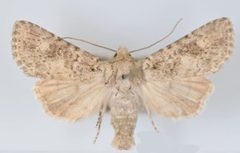
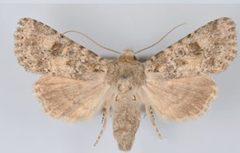
Aseptis catalina is a noctuid first described by John Bernhardt Smith in 1899. It occurs in desert regions of the southwestern United States and northwestern Mexico. The exhibits variable pale coloration with distinctive dark gray wing markings. activity is tied to winter rainfall patterns, occurring primarily in early spring.
Pronunciation
How to pronounce Aseptis catalina: //əˈsɛptɪs ˌkætəˈliːnə//
These audio files are automatically generated. While they are not always 100% accurate, they are a good starting point.
Identification
The combination of powdery pale forewings with dark gray-filled and claviform spots distinguishes this from most other Aseptis. The large postreniform patch that is only slightly lighter than the surrounding medial area is a notable feature. The black and white dots following the postmedial line on the , when present, provide additional diagnostic characters. Variation in ground color intensity requires comparison of multiple specimens. Similar species within Aseptis would require examination of genitalia or more subtle wing pattern differences for definitive identification.
Images
Appearance
Wingspan 30–33 mm. Forewings powdery pale yellow tan to very pale cream, with patchy contrasting darker gray markings. spot large, filled with dark gray; claviform spot similarly filled with dark gray. Postreniform patch large, only slightly lighter than adjacent medial area. Basal and postmedial areas darker than ground color. Antemedial and postmedial lines black, filled with pale cream; postmedial line often followed by black and white dots on . Subterminal area pale cream. Terminal line a series of black spots; fringe checkered. Hindwing pattern not described in sources. Color and tone of ground color variable, ranging from very pale cream to more tan. Maculation usually indistinct despite complete pattern.
Habitat
Desert environments. Specific microhabitat preferences not documented.
Distribution
Deserts of Arizona, California, and Baja California, Mexico.
Seasonality
fly early March to April, with timing dependent on winter rainfall. This represents an early period relative to many desert .
Life Cycle
Complete with , larva, pupa, and stages. Larval plants unknown. Specific developmental duration not documented.
Behavior
activity period closely tied to winter precipitation patterns, suggesting triggered by moisture availability and associated plant growth.
Similar Taxa
- Other Aseptis speciesShare similar wing pattern elements including and claviform spots; require detailed examination for separation
More Details
Taxonomic history
Originally described as Hadena catalina by Smith in 1899; later transferred to Aseptis.
Flight phenology note
The dependence on winter rainfall for timing is characteristic of many desert Lepidoptera in the southwestern United States and represents an to arid environments with seasonal precipitation.
Sources and further reading
- BugGuide
- Wikipedia
- GBIF taxonomy match
- iNaturalist taxon
- NCBI Taxonomy
- Catalogue of Life
- Meet Awesome Annie, the Scorpion, at UC Davis Biodiversity Museum Day | Bug Squad
- For peace in Colombia: five new species of pseudoscorpions
- Bug Eric: Wasp Wednesday: Steniolia elegans
- Bug Eric: Wasp Wednesday: Western Cicada Killer
- Nasty scale insects spell trouble for American beech trees: Beech bark scale, Cryptococcus fagisuga — Bug of the Week
- Bug Eric: Cicada Time