
Ufeus satyricus
Grote, 1873
Brown Satyr Moth
Species Guides
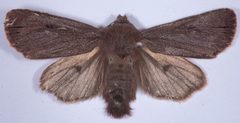
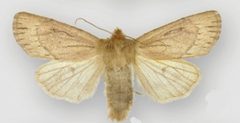
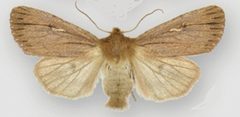
1Ufeus satyricus is a noctuid known as the Brown Satyr Moth. It is notable for as an , with adults emerging from pupae in summer and remaining active through fall, winter, and spring. The shows in forewing length, with females larger than males. It is closely associated with large poplar trees across its North American range.
Pronunciation
How to pronounce Ufeus satyricus: /ˈjuːfiːəs səˈtɪrɪkəs/
These audio files are automatically generated. While they are not always 100% accurate, they are a good starting point.
Identification
Males can be distinguished from females by forewing length (15–22 mm vs. 19–24 mm). The can be separated from Ufeus plicatus by genitalia . The two recognized are geographically separated: U. s. satyricus occurs east of the Rocky Mountain foothills, while U. s. sagittarius occurs from the eastern Rocky Mountains westward to the Pacific Coast.
Images
Appearance
Forewing length ranges from 15–22 mm in males and 19–24 mm in females. The exhibits sexual size dimorphism, with females consistently larger. Coloration and pattern details are not documented in available sources.
Habitat
Associated with stands of large poplar trees (Populus spp.), particularly cottonwood. Occurs in both eastern deciduous forest regions and western montane and riparian .
Distribution
Central and southern Canada from Atlantic to Pacific coasts; south to Pennsylvania and Illinois in the east; south to southern Arizona and California in the west.
Seasonality
emerge from pupae in summer and overwinter as adults. Active adults are recorded from late August through early May, with peak collection periods in October–November (fall) and March–April (spring). Adults have been observed during mild mid-winter spells.
Diet
Larvae feed on cottonwood (Populus spp.)
Host Associations
- Populus - larval food plantspecifically cottonwood
Life Cycle
Overwinters as . Adults emerge from pupae in summer, then enter extended adult or through fall and winter, with resumed activity in spring.
Behavior
are active during mild periods throughout winter, suggesting cold-hardiness and opportunistic activity patterns. is atypical among noctuid .
Similar Taxa
- Ufeus plicatusOverlapping geographic range and similar association with poplar; distinguished by genitalia
More Details
Subspecies
Two recognized: U. s. satyricus (eastern North America west to Rocky Mountain foothills) and U. s. sagittarius Grote, 1883 (eastern Rocky Mountains in Alberta, Montana, Colorado west to Pacific Coast). The subspecies distinction is primarily geographic.