
Ufeus plicatus
Grote, 1873
Folded Satyr
A small noctuid to northeastern North America, closely tied to large poplars—especially eastern cottonwood—growing in riparian with loose, rotting bark. exhibit an unusual bimodal activity pattern with spring followed by summer and renewed fall activity. The is notably scarce at light traps despite occurring in suitable habitats.


Pronunciation
How to pronounce Ufeus plicatus: /ˈjuːfiəs plaɪˈkeɪtəs/
These audio files are automatically generated. While they are not always 100% accurate, they are a good starting point.
Identification
Distinguished from by association with eastern cottonwood in riparian with loose bark; spring-emerging aestivate through summer, with peak activity in fall (October–November) and early spring (March–April). The scarcity at light traps contrasts with typical noctuid .
Images
Appearance
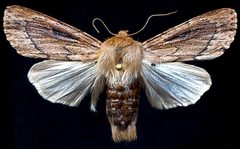
Forewing length 16–19 mm in males, 17–20 mm in females. Specific wing pattern details are not documented in available sources.
Habitat
Riparian zones with large poplars, especially eastern cottonwood (Populus deltoides) in moist areas along rivers. Requires abundant loose, rotting strips of bark near the base of trees for larval and shelter.
Distribution
Recorded from Illinois, Iowa, Minnesota, Missouri, Nebraska, Pennsylvania, southern Quebec, Connecticut, and Vermont. Likely widespread in northeastern North America where suitable riparian cottonwood occurs.
Seasonality
laid in spring. emerge late spring–early summer but primarily aestivate until fall. Active adults recorded in all months except June; peak records October–November and March–April.
Diet
Larvae feed on Populus deltoides (eastern cottonwood). feeding habits unknown.
Host Associations
- Populus deltoides - larval Larvae feed on foliage; hide under loose bark strips during day.
Life Cycle
laid in spring. Larvae develop on foliage, sheltering under bark by day. details unknown. emerge late spring to early summer, aestivate through summer months, then become active in fall. likely occurs as adults under bark.
Behavior
Larvae and hide under loose strips of tree bark during daylight hours. Adults are weakly attracted to light relative to other noctuids. Summer is a notable deviation from typical continuous adult activity in the .
Ecological Role
Herbivore specializing on large, mature eastern cottonwoods in riparian . Larval feeding contributes to nutrient cycling in these .
Human Relevance
No documented economic or cultural significance. Of interest to lepidopterists due to its specialized requirements and unusual .
Similar Taxa
- Other Ufeus species share -level traits but differ in associations and geographic distribution; U. plicatus is distinguished by its specific tie to eastern cottonwood in northeastern riparian zones.
- Generalist NoctuidaeUnlike most noctuids, U. plicatus shows weak attraction to light and highly specific microhabitat requirements (loose bark on large poplars), making it scarce in standard survey methods.
More Details
Etymology
Specific epithet 'plicatus' (Latin: folded, pleated) likely refers to the habit of hiding in folded bark strips.
Conservation Notes
Dependence on large, mature eastern cottonwoods in undisturbed riparian zones makes this vulnerable to alteration from river management, agriculture, and urbanization.