
Tholera
Hübner, 1821
Feathered Gothic
Species Guides
1- Tholera americana(American cutworm)
Tholera is a of noctuid comprising approximately five distributed across the Palearctic region. The most extensively studied species, Tholera decimalis (Feathered Gothic), has served as a model for genomic and ecological research. Males of this genus are characterized by prominently feathered , an for detection. of Tholera decimalis experienced significant decline and range contraction during the late 20th century, followed by partial recovery and expansion in recent decades.
Pronunciation
How to pronounce Tholera: /ˈθo.lɛ.ra/
These audio files are automatically generated. While they are not always 100% accurate, they are a good starting point.
Identification
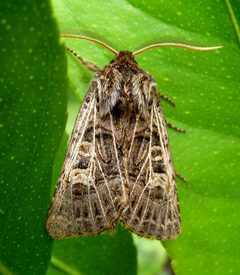
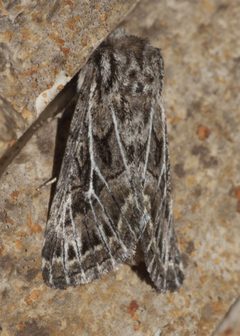
Males possess strongly bipectinate (feathered) , a distinctive trait that gives T. decimalis its . This feature is likely an for increased olfactory surface area to detect female . The can be distinguished from related noctuids by this pronounced antennal structure in males, though -level identification requires examination of genitalia or wing pattern details.
Images
Habitat
in this inhabit rough grassland, downland, and open woodland. These environments provide the grassy vegetation required for larval development.
Distribution
The occurs across the Palearctic. Tholera decimalis is currently widespread in England and Wales, particularly in southern counties, but absent from most of Scotland and very rare in Ireland and Northern Ireland. Records extend across Eurasia with concentrations in the Netherlands, Austria, Switzerland, and Scandinavia, plus sporadic occurrences eastward through Russia to Mongolia. Distribution records from GBIF confirm presence in Denmark, Norway, and Sweden.
Seasonality
are active during August and September. overwinter, with larvae feeding between March and July.
Diet
Larvae feed on grasses.
Life Cycle
overwinter and hatch in spring. Larvae feed on grasses from March through July before pupating. emerge in August and September to reproduce.
Behavior
Males have been observed to show no electroantennogram response to 30 putative components that elicit responses in related noctuid , suggesting unusual or specialized pheromone chemistry in this .
Human Relevance
Tholera decimalis has been the subject of genomic research; its assembly of 1,334.1 Mb with 31 chromosomal pseudomolecules provides a resource for lepidopteran comparative . The serves as an indicator of grassland quality and has been monitored for trends reflecting landscape- environmental changes.
Similar Taxa
- Other Noctuinae generaLack the pronounced bipectinate in males that characterize Tholera; may require dissection for definitive separation.
More Details
Genomic Resources
A -level assembly is available for Tholera decimalis, comprising 1,334.1 Mb across 30 plus the Z , with a 15.4 kb mitochondrial genome and 12,771 annotated protein-coding genes.
Population Trends
Tholera decimalis experienced large abundance declines since 1970 with associated geographic range contraction, followed by more recent range expansion. These dynamics make the relevant for studies of climate and land-use change impacts on insect .