
Spodoptera praefica
Grote, 1875
Western Yellow-striped Armyworm, Western Yellow-striped Armyworm Moth
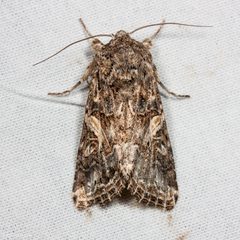
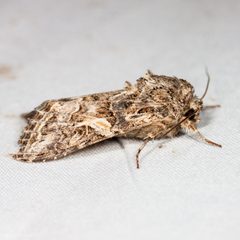
Spodoptera praefica, the western yellow-striped , is a noctuid native to western North America. The has two periods annually, occurring in early spring and late summer. Larvae are black with yellow stripes and feed on herbaceous plants including several agricultural crops. The species is considered a high risk for invasion into the European and Mediterranean region but is currently absent from that area.
Pronunciation
How to pronounce Spodoptera praefica: /spoʊˈdɒptərə priˈfɪkə/
These audio files are automatically generated. While they are not always 100% accurate, they are a good starting point.
Identification
distinguished from the similar by paler forewings lacking the blurry white stripe, and by hindwings that are white or gray with a small brown dot on the surface. Larvae recognized by the black body with yellow stripes and inverted "Y" marking on the .
Images
Habitat
Associated with herbaceous vegetation in agricultural and natural settings. Larvae feed on leaves of various herbaceous plants.
Distribution
Native to western North America: from British Columbia to California, east to Utah, and north to Alberta. Absent from the EPPO (European and Mediterranean Plant Protection Organization) area as of October 2021.
Seasonality
active March–April and August–September. Two distinct periods annually.
Diet
Larvae feed on leaves of herbaceous plants including agricultural crops: alfalfa, potato, rice, sugar beet, and sweet potato.
Host Associations
- alfalfa - larval food plantagricultural crop
- potato - larval food plantagricultural crop
- rice - larval food plantagricultural crop
- sugar beet - larval food plantagricultural crop
- sweet potato - larval food plantagricultural crop
Life Cycle
Complete with , larva, pupa, and stages. Larvae are the feeding and damaging stage. Two annually corresponding to the bimodal adult periods.
Behavior
attracted to ultraviolet light sources. Larvae feed externally on foliage.
Ecological Role
Herbivore; larval stage functions as a folivore on herbaceous plants. Potential agricultural pest.
Human Relevance
Agricultural pest of several crops. Considered a high risk for invasion into Europe and the Mediterranean region, with potential to become established as a pest in that area. Subject to monitoring by plant protection organizations.
Similar Taxa
- Spodoptera ornithogalliSimilar appearance, but S. ornithogalli has darker forewings with a blurry white stripe and different hindwing pattern.
- Spodoptera exiguaBoth are Spodoptera with larval stages that can be pests of agricultural crops, but S. exigua larvae are typically green above and pinkish or yellowish below with a white lateral stripe.
More Details
Invasion Risk
As of 4 October 2021, the is absent from the EPPO area but considered a high risk for invasion there.
Blacklight Attraction
have been documented visiting blacklighting displays in California, indicating activity and attraction to UV light sources.
Sources and further reading
- BugGuide
- Wikipedia
- GBIF taxonomy match
- iNaturalist taxon
- NCBI Taxonomy
- Catalogue of Life
- Oh, What a (Moth) Night! | Bug Squad
- Blacklighting at the Bohart: They Saw the Light | Bug Squad
- What Will You See at Bohart Museum Open House | Bug Squad
- Quick Guide to Armyworms on Soybean | Beetles In The Bush
- How Artificial Intelligence Could Make It Easier to ID Common Corn Pests
- Noctuidae | Beetles In The Bush | Page 2