
Xestia tecta
(Hübner, 1808)
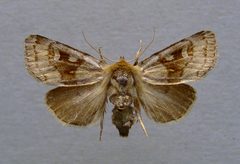
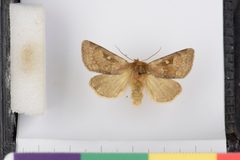
Xestia tecta is a noctuid with a disjunct Holarctic distribution, occurring in Fennoscandia and northwestern Russia in Europe, and across northern Siberia, Alaska, and north-central North America. The has a two-year , with active from July to August. Males are while females are active in the afternoon.
Pronunciation
How to pronounce Xestia tecta: //ˈzɛs.ti.ə ˈtɛk.tə//
These audio files are automatically generated. While they are not always 100% accurate, they are a good starting point.
Identification
can be distinguished by their July–August period in , combined with the ' disjunct distribution. Males are active at night, females in the afternoon—a behavioral difference that may aid identification. Larvae are reddish brown with a white lateral band. The two-year is unusual among noctuids and may serve as a distinguishing feature where ecological data are available.
Images
Habitat
and subarctic regions. In Europe, restricted to the boreal zone of Fennoscandia and adjacent northwestern Russia. Occupies tundra and taiga environments with dwarf birch and Vaccinium shrubs.
Distribution
Europe: Fennoscandia, northwestern Russia, northern Ural Mountains. Asia: northern and central Siberia. North America: Alaska, northwestern USA, northwestern and central Canada.
Seasonality
on wing July to August. Two-year with extended larval development.
Diet
Larvae feed on dwarf birch (Betula nana) and hardwood shrubs including huckleberries (Vaccinium spp.).
Host Associations
- Betula nana - larval food plantdwarf birch
- Vaccinium - larval food planthuckleberries and related shrubs
Life Cycle
The takes two years to reach maturity. presumably laid in late summer; larvae overwinter twice, with development spanning two growing seasons. and occur in July–August.
Behavior
Males are strictly . Females are active in the afternoon, showing pronounced sexual difference in daily activity patterns.
Ecological Role
Herbivorous larval stage contributes to nutrient cycling in shrub . As a feeder on dwarf birch and Vaccinium, likely plays a role in regulating shrub in tundra and taiga .
Human Relevance
No significant direct economic impact. Presence indicates intact or subarctic with native shrub vegetation.