
Noctua
Yellow Underwings
Species Guides
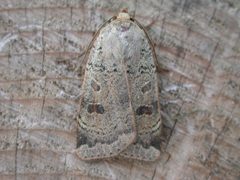
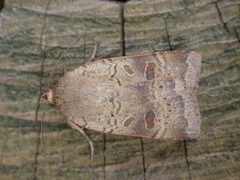
2- Noctua comes(Lesser Yellow Underwing)
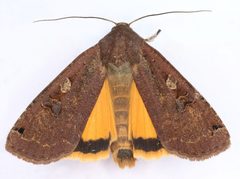
- Noctua pronuba(Large Yellow Underwing)
Noctua is a of in the Noctuidae, commonly known as yellow underwings. They are characterized by dull, cryptic forewings that conceal brightly colored hindwings when at rest. The genus contains well-known such as Noctua pronuba (large yellow underwing), which has been studied for its remarkable mechanisms. These moths are capable fliers and are primarily .
Pronunciation
How to pronounce Noctua: //ˈnɔk.tu.a//
These audio files are automatically generated. While they are not always 100% accurate, they are a good starting point.
Identification
Distinguished from similar Noctuidae by the combination of cryptic forewings and concealed bright hindwings. Separated from 'true' underwing moths (Catocala) by wing venation and genitalia; Catocala typically have more elongated forewings and different resting posture. Noctua pronuba specifically identified by large size, broad yellow hindwing with black terminal band, and forewing spot with pale ring.
Images
Appearance
Forewings are typically dull brown or gray with cryptic patterning that provides camouflage against substrates. Hindwings are often bright yellow, orange, or red with dark bands or spots. When at rest, the hindwings are folded beneath the forewings and completely hidden. Body is stout and furry. are threadlike or slightly feathered in males.
Habitat
Found in diverse terrestrial including grasslands, woodlands, gardens, and agricultural areas. Many occupy open habitats with herbaceous vegetation. Some species adapted to human-modified environments.
Distribution
Holarctic distribution, with occurring across Europe, Asia, and North America. Several species have expanded their ranges through human activity, including Noctua pronuba which has been introduced to North America.
Seasonality
active primarily from late spring through autumn, with peak activity varying by and latitude. Some species are multivoltine with multiple per year. Larval stages present during growing season.
Behavior
activity pattern. are strong fliers and frequently attracted to artificial light sources. When disturbed, they flash their bright hindwings in a startle display that may confuse . The of Noctua pronuba has been documented to undergo light through of photopigment between Semper and the clear zone, a process taking approximately 30 minutes.
Ecological Role
Larvae function as herbivores, consuming various herbaceous plants. serve as prey for bats, birds, and other . Their abundance and widespread distribution make them significant components of .
Human Relevance
Some are minor agricultural pests as larvae. Frequently encountered by citizen scientists and enthusiasts due to attraction to light. Noctua pronuba has been extensively studied using optical coherence tomography to document live , representing a novel application of medical imaging technology to entomology.
Similar Taxa
- CatocalaBoth called 'underwing' due to concealed bright hindwings, but Catocala have more elongated forewings, different resting posture with wings held flat rather than tent-like, and are not closely related within Noctuoidea.
- Erebidae (underwing moths)Similar and hindwing concealment strategy, but distinct with different morphological characteristics.
More Details
Etymology
The name Noctua is Latin for 'little owl', though the are unrelated to owls.
Research significance
Noctua pronuba was the first studied using optical coherence tomography (OCT) to visualize live , demonstrating the of photopigment during light and dark adaptation in real time.