
Cerastis fishii
Grote, 1878
Fish's Dart
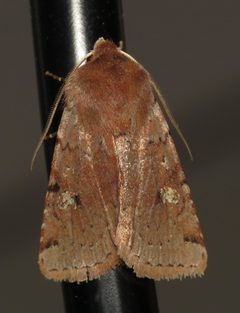
Cerastis fishii is a noctuid of eastern North America, commonly known as Fish's Dart. are active in spring, with a period from March through June. The has a wingspan of 30–36 mm. Larvae feed specifically on blueberry flowers and leaves.
Pronunciation
How to pronounce Cerastis fishii: /sɛˈræstɪs ˈfɪʃi.aɪ/
These audio files are automatically generated. While they are not always 100% accurate, they are a good starting point.
Identification
Can be distinguished from other Cerastis by geographic range and timing. The spring flight period (March–June) and eastern North American distribution help separate it from western . Definitive identification may require examination of genitalia or reference to regional faunal treatments.
Images
Appearance
Wingspan 30–36 mm. As a member of the Cerastis, likely exhibit the muted brown and gray coloration typical of noctuid , though specific pattern details are not documented in available sources.
Habitat
Associated with blueberry in eastern North America. Specific habitat requirements beyond plant presence are not documented.
Distribution
Eastern North America. In Canada: Newfoundland to southern Ontario. In the United States: western Maine to Ohio, Michigan, and northern Wisconsin, south to North Carolina and Tennessee.
Seasonality
on wing from March to June. with a single spring .
Diet
Larvae feed on flowers and leaves of blueberry (Vaccinium spp.). feeding habits are not documented.
Host Associations
- Vaccinium - larval plantflowers and leaves
Life Cycle
Complete with , larva, pupa, and stages. Larvae feed on blueberry during growing season. likely occurs in soil or leaf litter. Adults emerge in spring.
Behavior
activity typical of Noctuidae. Specific behavioral details beyond period are not documented.
Ecological Role
Larval herbivore on blueberry; may function as a visitor or minor pest in blueberry . Specific ecological impacts are not quantified.
Human Relevance
Minor potential relevance to blueberry as a foliar and floral feeder. Not known as a significant agricultural pest.
Similar Taxa
- Cerastis tenebriferaOverlapping eastern North American range; may require genital dissection or molecular methods for definitive separation
- Other Cerastis speciesWestern North American are ; eastern may overlap in range and require careful examination