
Cerastis
Ochsenheimer, 1816
Species Guides
6- Cerastis cornuta(Enigmatic Dart and Close Allies)
- Cerastis enigmatica(Enigmatic Dart)
- Cerastis fishii(Fish's Dart)
- Cerastis gloriosa
- Cerastis salicarum(Willow Dart)
- Cerastis tenebrifera(Reddish Speckled Dart)
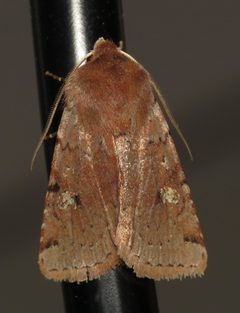
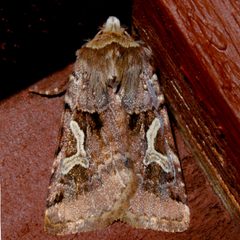
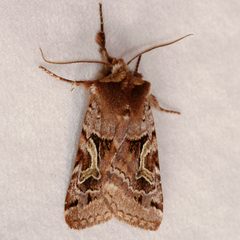
Cerastis is a of noctuid established by Ochsenheimer in 1816. The genus contains approximately 12 described distributed primarily across the Holarctic region, with some species extending into East Asia. The genus includes two subgenera: the nominate Cerastis and Metalepsis. Several species are notable spring-flying moths with reddish or brownish coloration, including the well-studied Cerastis rubricosa (Red Chestnut).
Pronunciation
How to pronounce Cerastis: //kɛˈræs.tɪs//
These audio files are automatically generated. While they are not always 100% accurate, they are a good starting point.
Images
Habitat
Deciduous woodland; low-growing herbaceous vegetation. Specific data documented for C. rubricosa in Wytham Woods, Oxfordshire, and coastal regions in Ireland.
Distribution
Central and northern Europe; scattered records from Russia, Ukraine, China, and Hokkaido, Japan; Britain from northern Scotland to southern England, through south and west Wales and across much of Northern Ireland; Ireland mainly coastal. GBIF records also indicate presence in Denmark, Norway, Sweden, and Vermont, USA.
Seasonality
of C. rubricosa recorded March to May; larvae feed in summer. One per year documented for this .
Diet
larvae feed on wide range of low-growing herbaceous plants. Documented for C. rubricosa: dock (Rumex sp.), dandelion (Taraxacum officinale), groundsel (Senecio vulgaris), and orchids. Larvae feed on orchid flowers before switching to leaves and stem.
Host Associations
- Rumex sp. - larval food plant
- Taraxacum officinale - larval food plant
- Senecio vulgaris - larval food plant
- Gymnadenia conopsea - larval food plantFragrant orchid; larvae feed on flowers before switching to leaves and stem
- orchids - larval food plantsignificant herbivore in Norway study
Life Cycle
One per year; active March to May; larval feeding in summer. details not documented in available sources.
Behavior
Larvae of C. rubricosa are highly mobile and can move between plants to select preferred food source. Spring-flying activity period.
Ecological Role
Herbivore; significant herbivore of orchids in Norway study, sometimes consuming all above-ground plant parts.
Human Relevance
C. rubricosa sequenced (678.7 Mb assembly, 31 chromosomal pseudomolecules, 18,784 protein-coding genes annotated) as part of Darwin Tree of Life project.
More Details
Subgeneric classification
Cerastis contains two subgenera: nominate Cerastis and Metalepsis (revised by Crabo & Lafontaine 1997). The Metalepsis subgenus includes the C. cornuta group : C. cornuta, C. enigmatica, C. fishii, C. gloriosa, and C. salicarum.
Genomic resources
Cerastis rubricosa assembly available: 678.7 Mb total size, 31 chromosomal pseudomolecules (30 + Z ), 15.39 kb mitochondrial genome, 18,784 protein-coding genes annotated. Specimen from Wytham Woods, Oxfordshire, UK.