
Feltia jaculifera
Guenée, 1852
Dingy Cutworm Moth, Bent-line Dart, Dingy Cutworm
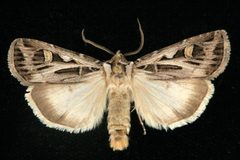
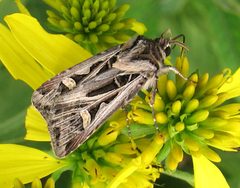
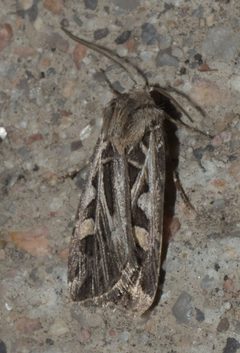
Feltia jaculifera, commonly known as the dingy or bent-line dart, is a widespread noctuid moth found throughout North America. are and active from July to November, often attracted to lights. The larvae are feeders known as cutworms, feeding on over forty plant including agricultural crops and garden vegetables. The species is frequently confused with three : F. herilis, F. subgothica, and F. tricosa.
Pronunciation
How to pronounce Feltia jaculifera: //ˈfɛl.ti.ə dʒəˌkjuː.lɪˈfɛr.ə//
These audio files are automatically generated. While they are not always 100% accurate, they are a good starting point.
Identification
distinguished from similar Feltia by the W-shaped white markings formed where lines meet the subterminal line on the forewing. Larvae identified by the four black dots on each abdominal segment. Often confused with F. herilis, F. subgothica, and F. tricosa; precise identification may require examination of genitalia or molecular methods.
Images
Habitat
Fields, gardens, waste areas, and open . found nectaring and resting on composite flowers in late afternoon in arid regions. Larvae occur in soil and ground-level vegetation.
Distribution
Common throughout North America. Documented from Canada (Alberta, Manitoba, Saskatchewan) and the United States (including Vermont and widespread across the continent).
Seasonality
fly from July to November. Larvae overwinter and emerge in spring.
Diet
Larvae feed on more than forty plant including alfalfa, aster, blueberry, chickweed, clover, corn, dock, flax, goldenrod, garden vegetables, grasses, mullein, oats, raspberry, rye, tobacco, and wheat.
Life Cycle
Complete . active mid-summer through fall. Females oviposit in flower , particularly Asteraceae. hatch into larvae that overwinter in soil, emerging in spring to feed. Larvae feed on diverse plants before pupating.
Behavior
, attracted to lights. In arid areas, adults nectar and rest on composite flowers during late afternoon. Females oviposit in flower buds. Larvae are subterranean cutworms that feed at or below ground level.
Ecological Role
Larvae act as herbivores, consuming diverse plant material. serve as when nectaring. Serves as for ichneumon Ceratogastra ornata, which oviposits in or early larval stages.
Human Relevance
Agricultural and garden pest due to larval feeding damage on crops including corn, wheat, oats, tobacco, alfalfa, clover, and various vegetables. Damage caused by larvae cutting stems and feeding on roots and foliage.
Similar Taxa
- Feltia herilisSimilar dark forewing pattern; distinguished by subtle differences in wing markings and genitalia
- Feltia subgothicaOverlapping range and similar appearance; requires careful examination of wing patterns or genitalia for separation
- Feltia tricosaFrequently confused with F. jaculifera; differences in wing pattern details and genitalia
Sources and further reading
- BugGuide
- Wikipedia
- GBIF taxonomy match
- iNaturalist taxon
- NCBI Taxonomy
- New Management Methods Emerge for Walnut Husk Fly
- Bug Eric: Ichneumon Wasp: Ceratogastra ornata
- Balancing Eradication and Management: The Role of Biocontrol in Asian Longhorned Beetle Defense
- How a City-Raised Entomologist Found Her Path in Agricultural Pest Management
- New Guide Offers Latest in Carrot Weevil Management
- Bug Eric: December 2013