
Feltia subgothica
(Haworth, 1809)
gothic dart, subgothic dart, tricose dart
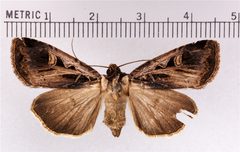
Feltia subgothica, commonly known as the gothic dart or subgothic dart, is a noctuid found in central North America. have a wingspan of approximately 34 mm and are active from July to September. The species is notable for its larvae, which have been documented feeding on over 40 plant species spanning crops, forages, vegetables, and forbs.


Pronunciation
How to pronounce Feltia subgothica: /ˈfeltɪə səbˈɡɒθɪkə/
These audio files are automatically generated. While they are not always 100% accurate, they are a good starting point.
Identification
are medium-sized noctuid with a wingspan near 34 mm. Distinguishing Feltia subgothica from other dart moths (Feltia and related ) requires examination of genitalic structures and subtle wing pattern differences not reliably visible in field conditions. The species is part of a complex of similar-looking cutworm moths that are often difficult to separate without dissection.
Images
Appearance
have a wingspan of approximately 34 mm. The exhibits typical noctuid with cryptic coloration.
Habitat
Found in a variety of open and semi-open across central North America. Larval plant diversity suggests adaptability to agricultural fields, grasslands, and disturbed areas.
Distribution
Central North America, ranging north to Quebec, Ontario, and Saskatchewan in Canada. Records also exist from Alberta and Manitoba. The is present throughout the mid-continent of the United States.
Seasonality
are on wing from July to September, with peak activity during late summer.
Diet
Larvae are highly , having been reported from over 40 plant including crops, forages, vegetables, and forbs. Specific plants documented include agricultural crops and wild herbaceous plants.
Life Cycle
Complete with , larva, pupa, and stages. Larvae are subterranean cutworms that feed on plant stems and roots. occurs in soil. Adults emerge in mid to late summer.
Behavior
Larvae exhibit typical , feeding at or below ground level on plant stems and roots, often severing seedlings at the soil surface. are and attracted to light.
Ecological Role
Larvae function as herbivores. The serves as a for , including Ceratogastra ornata (Ichneumonidae), which parasitizes or early-instar larvae.
Human Relevance
Economic pest status in agriculture due to larval feeding damage on multiple crop . Larval polyphagy results in potential impact across diverse agricultural systems. Management may be required when are high in cultivated areas.
Similar Taxa
- Other Feltia speciesMany Feltia dart moths share similar size, coloration, and wing patterns; genitalic dissection often required for definitive identification.
- Other Noctuidae cutwormsNumerous noctuid contain with comparable and ; expert examination needed for separation.
More Details
Parasitoid relationships
Feltia subgothica is a documented for the ichneumon Ceratogastra ornata, which oviposits into laid in flower buds. This relationship has been observed on Ambrosia artemisiifolia (common ragweed) and Eupatorium thoroughworts.
Sources and further reading
- BugGuide
- Wikipedia
- GBIF taxonomy match
- iNaturalist taxon
- NCBI Taxonomy
- New Management Methods Emerge for Walnut Husk Fly
- Bug Eric: Ichneumon Wasp: Ceratogastra ornata
- Balancing Eradication and Management: The Role of Biocontrol in Asian Longhorned Beetle Defense
- How a City-Raised Entomologist Found Her Path in Agricultural Pest Management
- New Guide Offers Latest in Carrot Weevil Management
- Bug Eric: December 2013