
Feltia tricosa
Lintner, 1874
tricose dart
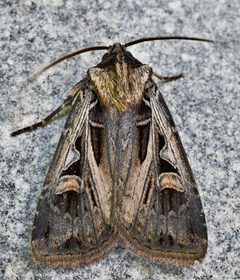
Feltia tricosa, commonly known as the tricose dart, is a noctuid found in central North America. The has a wingspan of approximately 35 mm. are active from July through September in northern portions of its range. The larvae are subterranean cutworms that have been observed feeding on a variety of plants. This species is notable as a for the ichneumon Ceratogastra ornata, which parasitizes its and early larval stages.
Pronunciation
How to pronounce Feltia tricosa: /ˈfɛl.ti.ə ˈtraɪ.kə.sə/
These audio files are automatically generated. While they are not always 100% accurate, they are a good starting point.
Identification
Images
Appearance
have a wingspan of approximately 35 mm. Detailed physical descriptions of coloration and pattern are not available in the provided sources.
Habitat
Specific preferences for this are not documented. As a member of the Feltia, it likely occupies open habitats including fields, meadows, and agricultural areas where larval plants are available.
Distribution
Central North America, ranging north to Quebec, Ontario, and Manitoba in Canada. GBIF records also indicate presence in Alberta, Saskatchewan, and Vermont.
Seasonality
are on wing from July to September in northern portions of the range. Activity periods may extend earlier or later in more southerly latitudes.
Diet
Larvae probably feed on a wide variety of plants, though specific records are not documented.
Host Associations
- Ceratogastra ornata - Ichneumon that parasitizes or newly-hatched larvae; observed ovipositing into flower buds where Feltia eggs are laid
Life Cycle
Females lay in flower buds of plants such as Ambrosia artemisiifolia (common ragweed) and Eupatorium (thoroughworts). Caterpillars hatch and migrate to the ground, completing their development as subterranean cutworms. occurs underground. The has one per year in northern areas.
Behavior
Females have been observed laying in the buds of certain flowering plants. The resulting caterpillars migrate from the flower buds to the soil to complete development.
Ecological Role
Larvae function as herbivores, feeding on plant material. The serves as a for , contributing to local dynamics.
Human Relevance
Larvae may occasionally damage crops or garden plants as cutworms, though specific economic impact is not documented.
Similar Taxa
- Other Feltia speciesMultiple congeneric dart moths share similar appearance and habits; microscopic examination typically required for separation
More Details
Sources and further reading
- BugGuide
- Wikipedia
- GBIF taxonomy match
- iNaturalist taxon
- NCBI Taxonomy
- New Management Methods Emerge for Walnut Husk Fly
- Bug Eric: Ichneumon Wasp: Ceratogastra ornata
- Balancing Eradication and Management: The Role of Biocontrol in Asian Longhorned Beetle Defense
- How a City-Raised Entomologist Found Her Path in Agricultural Pest Management
- New Guide Offers Latest in Carrot Weevil Management
- Bug Eric: December 2013