
Feltia herilis
Grote, 1873
Master's Dart, Herald Dart
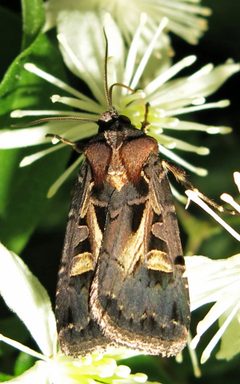
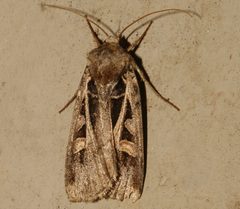
Feltia herilis, commonly known as Master's Dart or Herald Dart, is a noctuid native to North America. First described by Augustus Radcliffe Grote in 1873, this has one per year with active from July through October. The larvae are , feeding on a wide variety of plants including crops, forages, vegetables, forbs, and herbs. Adults have been observed feeding on nectar, with one documented instance on Liatris.

Pronunciation
How to pronounce Feltia herilis: /ˈfɛl.ti.ə ˈhɛ.rɪ.lɪs/
These audio files are automatically generated. While they are not always 100% accurate, they are a good starting point.
Identification
Can be distinguished from similar Feltia and other noctuid by examination of genitalia and specific wing pattern characteristics. The combination of geographic range, period (July–October), and association assists in field identification. Molecular identification may be required for definitive separation from closely related species.
Images
Appearance
have a wingspan of 34–44 mm. Forewings are typically dull brown to grayish-brown with variable darker markings. Hindwings are pale with darker margins. The overall coloration is cryptic, typical of many noctuid . Specific diagnostic markings for this require examination of wing pattern details and genitalia.
Habitat
Occupies diverse across its broad North American range. Larval habitat includes agricultural fields, grasslands, and areas with herbaceous vegetation where plants grow. are attracted to light and may be found in various terrestrial environments including urban areas.
Distribution
Native to North America. Range extends from Vancouver Island, British Columbia to Newfoundland and Labrador, north to the Northwest Territories border, and south to the Gulf Coast of the United States. Present in Canadian provinces including Alberta, Manitoba, and Saskatchewan, and throughout the contiguous United States within these latitudinal bounds.
Seasonality
are on wing from July to October. The has one per year ().
Diet
Larvae feed on a wide variety of plants including crops, forages, vegetables, forbs, and herbs. have been reported to feed on nectar, with one observation on Liatris.
Host Associations
- Liatris - nectar sourcesingle documented observation
Life Cycle
Complete with one per year. are laid on plants. Larvae feed on vegetation and overwinter in the soil as mature larvae or pupae. emerge in mid-summer and are active through autumn.
Behavior
are and attracted to light. Larvae are subterranean cutworms that feed on plant stems and roots at or below ground level.
Ecological Role
Larvae function as herbivores in terrestrial . The serves as for , including the ichneumon wasp Ceratogastra ornata, which parasitizes or early instar larvae.
Human Relevance
Larvae can be agricultural pests due to their feeding habits on crops and vegetables. The is of interest in ecological studies of noctuid and - relationships.
Similar Taxa
- Other Feltia speciesSimilar and overlapping ranges; require genitalia examination or molecular analysis for definitive identification
- Agrotis speciesFormerly classified in Agrotis; similar larval habits and
More Details
Parasitoid Association
Documented of the ichneumon Ceratogastra ornata, which oviposits into laid in flower buds of plants such as Ambrosia artemisiifolia (Common Ragweed) and Eupatorium .
Sources and further reading
- BugGuide
- Wikipedia
- GBIF taxonomy match
- iNaturalist taxon
- NCBI Taxonomy
- New Management Methods Emerge for Walnut Husk Fly
- Bug Eric: Ichneumon Wasp: Ceratogastra ornata
- Balancing Eradication and Management: The Role of Biocontrol in Asian Longhorned Beetle Defense
- How a City-Raised Entomologist Found Her Path in Agricultural Pest Management
- New Guide Offers Latest in Carrot Weevil Management
- Bug Eric: December 2013