
Euxoa scandens
(Riley, 1869)
white cutworm, white cutworm moth
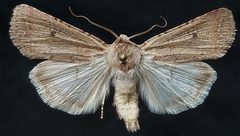
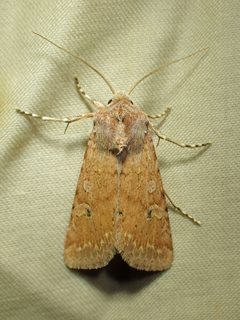
Euxoa scandens, commonly known as the white , is a noctuid native to North America. It is recognized as a sporadic agricultural pest, particularly affecting tobacco in Quebec, asparagus in Michigan, and various vegetable crops grown in light sandy soils. The exhibits a with larvae and resuming feeding in spring, causing significant damage to young plants. moths emerge and oviposit from late June through late July. Research has focused on developing female -based monitoring systems to improve management of this pest.

Pronunciation
How to pronounce Euxoa scandens: //juːkˈsoʊ.ə ˈskæn.dɛnz//
These audio files are automatically generated. While they are not always 100% accurate, they are a good starting point.
Identification
Euxoa scandens belongs to the dart moth Euxoa, characterized by stout-bodied with typically dull, cryptic coloration. As a , larvae are likely smooth, cylindrical, and exhibit the typical "C-shaped" defensive curling when disturbed common to the genus. Specific diagnostic features distinguishing E. scandens from are not documented in available sources; accurate identification may require examination of genitalia or molecular methods. The "white cutworm" suggests pale larval coloration, though this is not explicitly confirmed.
Images
Habitat
Associated with light sandy soils, particularly in agricultural settings. The is documented as a pest in cultivated fields including tobacco, asparagus, and vegetable crops.
Distribution
North America, with confirmed records from Canada (Quebec, Alberta, Manitoba, Saskatchewan) and the United States (Michigan). The MONA/Hodges number 10715 indicates its inclusion in North American faunal lists.
Seasonality
emerge and oviposit from late June until late July. larvae overwinter and resume feeding in spring.
Diet
Larvae feed on tobacco, asparagus, and other vegetable crops. The is described as a sporadic pest of these cultivated plants.
Host Associations
- tobacco - larval food plantDocumented as sporadic pest in Quebec
- asparagus - larval food plantDocumented as sporadic pest in Michigan
- vegetable crops - larval food plantGrown in light sandy soils
Life Cycle
larvae overwinter, causing serious damage when they resume feeding in spring. emerge and oviposit from late June until late July, suggesting a single per year.
Behavior
Larvae are likely feeders, consistent with habits. When disturbed, Euxoa larvae typically coil into a tight "C" shape as a defensive response. Female produce a that has been evaluated for use in monitoring.
Ecological Role
Sporadic agricultural pest; no documented natural role. Potential prey for and , though specific associations are not recorded.
Human Relevance
Agricultural pest of economic concern for tobacco, asparagus, and vegetable production. Research has focused on developing -based monitoring tools to improve timing of applications and estimate size and distribution.
Similar Taxa
- Euxoa auxiliaris, also a Noctuidae pest with similar larval habits and agricultural damage, but differs in distribution (western North America), (cereal grains, alfalfa), and ( migrate to alpine areas to aestivate)
- Euxoa mimallonisRuddy-winged dart, congeneric with similar but differs in associations and is not documented as a significant agricultural pest
More Details
Research Focus
Scientific attention has concentrated on identification and field evaluation for monitoring purposes rather than comprehensive . The 1982 Canadian Entomologist paper by McLeod and Dupré represents the primary available source on this ' biology.
Taxonomic Note
First described by Riley in 1869. The is part of the large and taxonomically challenging Euxoa, which contains numerous similar species requiring careful identification.
Sources and further reading
- BugGuide
- Wikipedia
- GBIF taxonomy match
- iNaturalist taxon
- NCBI Taxonomy
- Bug Eric: Winter 'pillars
- How Army Cutworm Moths Bounce Between Midwest Heat and Alpine Cool
- Botanizing at Elephant Rocks State Park | Beetles In The Bush
- Bug Eric: My Kind of Fourth of July
- December | 2021 | Beetles In The Bush
- FIELD AND LABORATORY EVALUATION OF A SEX ATTRACTANT FOR THE WHITE CUTWORM, EUXOA SCANDENS (LEPIDOPTERA: NOCTUIDAE)