
Protorthodes alfkenii
(Grote, 1895)
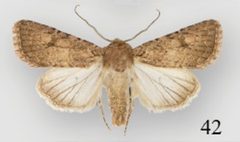
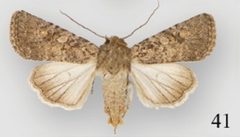
Protorthodes alfkenii is a small noctuid described by Grote in 1895. It exhibits extreme variation in size, ground color, and wing pattern across its range. The is distributed from the northwestern United States through Mexico and occupies open arid woodland . Despite its variability, it can be reliably identified by distinctive wing markings.
Pronunciation
How to pronounce Protorthodes alfkenii: //proʊˈtɔrθoʊˌdiz ælfˈkeɪni.aɪ//
These audio files are automatically generated. While they are not always 100% accurate, they are a good starting point.
Identification
The combination of rounded spot with thin black border (paler than ground color), oblique spot with lower portion projecting toward anal angle, and busy forewing appearance with longitudinal streaking distinguishes this from similar Protorthodes. Male hindwings are white with pearly sheen and limited fuscous shading; female hindwings usually retain pearly sheen despite potentially more extensive dark shading.
Images
Habitat
Open arid woodlands.
Distribution
North America from central Oregon, southern Idaho, central Wyoming, and northwestern Texas southward to southern Mexico.
Seasonality
Southern : April to late June, and early September to early November. Pacific Northwest populations: mid-July to late September.
Diet
Larvae feed on various herbaceous plants.
Similar Taxa
- Other Protorthodes speciesP. alfkenii is distinguished by the specific combination of rounded spot with thin black border, oblique spot projecting toward anal angle, and busy forewing with longitudinal streaking—features that collectively separate it from despite its own high variability.
More Details
Taxonomic History
Originally described as Perigea alfkenii by Grote in 1895. Later transferred to Trichopolia, and currently placed in Protorthodes. The Catalogue of Life lists it as a synonym of Trichopolia alfkenii, though GBIF and NCBI recognize Protorthodes alfkenii as the accepted name.