
Lacinipolia martini
Selman & Leuschner, 2001
cutworm moth, dart moth
Lacinipolia martini is a noctuid described in 2001 by Selman & Leuschner. It belongs to the owlet moth Lacinipolia, a group whose members are difficult to distinguish by external appearance alone. The species occurs in North America and is attracted to blacklights, with active during summer months. Like other Lacinipolia species, it is presumed to have a larval stage that functions as a , though specific details remain poorly documented.
Pronunciation
How to pronounce Lacinipolia martini: /læˌsɪnɪˈpoʊliə ˈmɑrtɪˌni/
These audio files are automatically generated. While they are not always 100% accurate, they are a good starting point.
Identification
within Lacinipolia cannot be reliably distinguished by external appearance alone; examination of genitalia is typically required for definitive identification. The MONA/Hodges number 10422.1 distinguishes this species numerically within North American classification systems.
Images
Appearance
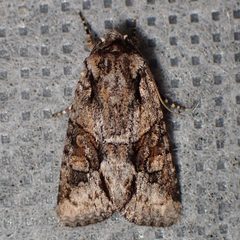
are medium-sized owlet moths. Based on characteristics, individuals likely exhibit mottled gray or greenish coloration with reflective on the wings. Lacinipolia typically have stout bodies and relatively broad forewings. Specific distinguishing features for L. martini are not documented in available sources.
Distribution
North America. Specific range details beyond continental presence are not documented.
Seasonality
have been observed in July during National Week events in Colorado, suggesting summer activity.
Behavior
are attracted to blacklights. No other specific are documented.
Similar Taxa
- Other Lacinipolia speciesCannot be distinguished by external appearance; genitalia examination required
More Details
Taxonomic history
Described by Selman & Leuschner in 2001, making it a relatively recently described within the large Noctuidae .
MONA/Hodges number
10422.1 — this decimal numbering indicates placement within the North American checklist system.
Sources and further reading
- BugGuide
- Wikipedia
- GBIF taxonomy match
- iNaturalist taxon
- NCBI Taxonomy
- Catalogue of Life
- “Mantises and Martinis”! The Chinese Praying Mantis, Tenodera aridifolia sinensis — Bug of the Week
- Bug Eric: My Personal National Moth Week, 2017
- Bug Eric: September 2017
- Invasive moth overlooked in EU for decades | Blog
- The Best of Denver: What to See and How to Get There During Entomology 2017
- The Story of the Little Fire Ant: Modern Medicine Learns From Indigenous Cultures