
Elaphria grata
Hübner, 1818
Grateful Midget, Grateful Midget Moth
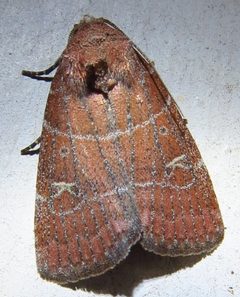
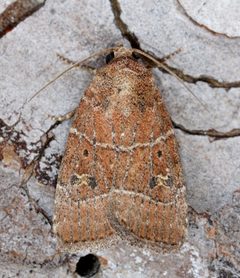
Elaphria grata is a small noctuid commonly known as the Grateful Midget. It is widespread across eastern and central North America, with active from spring through fall in multiple . The is frequently attracted to artificial lights and is a regular component of blacklight surveys in its range.
Pronunciation
How to pronounce Elaphria grata: /ɛˈlæfɹiə ˈɡɹɑːtə/
These audio files are automatically generated. While they are not always 100% accurate, they are a good starting point.
Identification
Distinguished from similar small noctuids by its compact size, grayish-brown forewings with subtle patterning, and the pale hindwings that contrast with the darker forewings. Separation from other Elaphria requires examination of genitalia or detailed wing pattern analysis. The 'Grateful Midget' reflects its small stature relative to other noctuids.
Images
Habitat
Occurs in a variety of wooded and semi-open including deciduous forests, forest edges, suburban areas, and parks. are frequently found near artificial light sources in residential areas.
Distribution
Eastern and central North America. Recorded from Alabama, Arkansas, Connecticut, Delaware, Florida, Georgia, Illinois, Indiana, Iowa, Kansas, Kentucky, Maine, Maryland, Massachusetts, Mississippi, Missouri, New Jersey, New York, North Carolina, Ohio, Oklahoma, Ontario, Pennsylvania, South Carolina, Tennessee, Texas, Virginia, West Virginia, and Wisconsin.
Seasonality
are active from April to October, with multiple per year. Peak activity varies by latitude, with longer seasons in southern portions of the range.
Diet
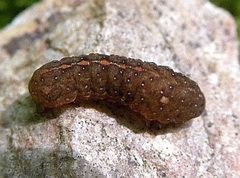
Larvae have been recorded feeding on forbs, Quercus (oak) , and dead leaves. feeding habits are not documented.
Host Associations
- Quercus - larval food plantoak
- forbs - larval food plantgeneral herbaceous plants
- dead leaves - larval fooddetritus feeding recorded
Life Cycle
Multivoltine, with multiple per year. Complete with , larval, pupal, and stages. Larvae are presumably ground-dwelling or leaf-litter feeders given recorded food sources.
Behavior
. are strongly attracted to artificial light sources and frequently appear at blacklight setups. They are active fliers during the night and rest on vegetation or substrates during daylight hours.
Ecological Role
Larvae function as herbivores and , consuming living plant material and dead leaves. likely serve as prey for including bats and birds. The contributes to nutrient cycling through larval detritus feeding.
Human Relevance
A common and widespread with no significant economic impact. Frequently encountered by citizen scientists during -watching events and blacklight surveys. Serves as an accessible subject for introducing observers to moth diversity due to its abundance and ease of attraction to lights.
Similar Taxa
- Other Elaphria speciesSimilar size and general appearance; require genital dissection or detailed wing pattern examination for definitive identification
- Small noctuids in related generaOverlap in size and ; Elaphria grata distinguished by specific wing pattern elements and pale hindwing coloration
More Details
Taxonomic note
The specific epithet 'grata' is Latin for 'pleasing' or 'grateful,' giving rise to the . The was described by Jacob Hübner in 1818.
Observation frequency
With over 8,700 observations on iNaturalist, this is among the more frequently documented small noctuid in eastern North America, reflecting both its abundance and its propensity to visit lights.
Sources and further reading
- BugGuide
- Wikipedia
- GBIF taxonomy match
- iNaturalist taxon
- NCBI Taxonomy
- Catalogue of Life
- Bug Eric: Last Night to Blacklight?
- 11 new species and a new rapid species description platform
- ocean species | Blog
- Bird droppings? Nope, clever moths and caterpillars looking like poop: Beautiful wood-nymph, Eastern tiger swallowtail, Black swallowtail, Red-spotted purple — Bug of the Week
- Bug Eric: National Moth Week 2021 Review
- Bug Eric: National Moth Week 2024 Recap from Kansas City