
Papaipema polymniae
Bird, 1917
Cup Plant Borer, Leafcup Borer Moth
Papaipema polymniae is a noctuid commonly known as the Cup Plant Borer or Leafcup Borer Moth. The is a herbivore whose larvae feed exclusively on Polymnia uvedalis (leafcup), a native North American plant in the sunflower . It has been documented in limited numbers in the northeastern United States.
Pronunciation
How to pronounce Papaipema polymniae: /pəˌpaɪˈpiːmə ˌpɒlɪmˈnai.iː/
These audio files are automatically generated. While they are not always 100% accurate, they are a good starting point.
Identification
The can be distinguished from other Papaipema by its documented association with Polymnia uvedalis as a larval . may require dissection or genitalia examination for definitive identification from , as external is often similar across the . The combination of geographic location (northeastern US) and host plant specificity provides the most reliable field identification cue.
Images
Appearance
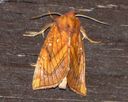
have a wingspan of approximately 40 mm. As a member of the Papaipema, it likely exhibits the typical noctuid body plan with a stout and relatively broad wings, though specific coloration and pattern details are not well documented in available sources.
Habitat
Associated with supporting its plant Polymnia uvedalis, which typically grows in moist, open woodlands, woodland edges, and stream banks. The has been recorded in Virginia, Massachusetts, and New Hampshire, suggesting a preference for deciduous forest in the northeastern United States.
Distribution
Documented from North America, specifically the northeastern United States including Virginia, Massachusetts, and New Hampshire. The appears to have a restricted range corresponding to the distribution of its plant.
Diet
Larvae feed on Polymnia uvedalis (leafcup), a herb in the Asteraceae . No other plants have been documented.
Host Associations
- Polymnia uvedalia - larval herbivore; sole documented food plant
Life Cycle
Larvae bore into the stems or roots of the plant, consistent with the 'Cup Plant Borer' and the typical of Papaipema . Specific details regarding sites, stage, and timing are not documented.
Behavior
Larval boring into plant tissues. activity patterns, including period and habits, are not specifically documented but are likely similar to other noctuid in the .
Ecological Role
As a herbivore, the contributes to the natural herbivore load on Polymnia uvedalis. Its role in the broader is poorly documented due to limited study and apparently low .
Human Relevance
No documented economic or agricultural significance. The is of potential interest to lepidopterists and conservation biologists due to its apparent rarity and specialized association.
Similar Taxa
- Other Papaipema speciesMany are morphologically similar and require dissection for definitive identification; plant association is the most reliable distinguishing feature for P. polymniae
More Details
Taxonomic history
Described by Bird in 1917. The epithet polymniae references the plant Polymnia (now treated as Polymnia uvedalia or Smallanthus uvedalia in some classifications). The 'Cup Plant Borer' derives from the former common name of the host plant, 'cup plant' or 'leafcup', referring to the perfoliate leaves that form a cup-like structure around the stem.
Conservation status
The is known from very few records (iNaturalist reports only one observation as of source date), suggesting it may be genuinely rare, locally distributed, or under-collected. Its dependence on a specific plant makes it potentially vulnerable to loss and host plant declines.