
Papaipema cerussata
Grote, 1864
ironweed borer moth
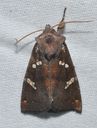
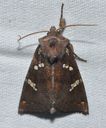
Papaipema cerussata, commonly known as the ironweed borer , is a noctuid moth found in eastern North America. The species is a stem-borer , with larvae that feed internally on the stems of Vernonia noveboracensis. It has been documented across seventeen states from Maine to Georgia. The specific epithet 'cerussata' refers to the lead-white coloration characteristic of this species.
Pronunciation
How to pronounce Papaipema cerussata: /pəˌpaɪˈpiːmə ˌsɛrʊˈseɪtə/
These audio files are automatically generated. While they are not always 100% accurate, they are a good starting point.
Identification
The specific epithet 'cerussata' (meaning lead-white) suggests distinctive pale coloration that may aid in identification. As a member of the Papaipema, it likely exhibits the slender body form and relatively plain forewings typical of stem-boring noctuids. Definitive identification may require examination of genitalia or larval association with Vernonia noveboracensis.
Images
Habitat
Associated with supporting its plant Vernonia noveboracensis (New York ironweed), which typically occurs in moist meadows, wet fields, stream banks, and woodland edges in eastern North America.
Distribution
Eastern North America: recorded from Georgia, Illinois, Indiana, Kentucky, Maine, Maryland, Michigan, New Jersey, New York, North Carolina, Ohio, Pennsylvania, South Carolina, Tennessee, Virginia, and West Virginia.
Diet
Larvae feed on Vernonia noveboracensis (New York ironweed), boring into stems. feeding habits are not documented.
Host Associations
- Vernonia noveboracensis - larval plantLarvae bore into stems
Behavior
Ecological Role
As a stem-borer, larvae may influence plant architecture and resource allocation in Vernonia noveboracensis . May serve as prey for and other natural enemies.
Human Relevance
No documented economic or agricultural significance. Of potential interest to lepidopterists and conservation biologists monitoring herbivore- plant relationships.
Similar Taxa
- Papaipema speciesOther Papaipema are also stem-borers with similar ; differentiation requires examination of genitalia or plant association. P. cerussata is distinguished by its specific association with Vernonia noveboracensis and likely by genitalic characters.
More Details
Taxonomic History
Originally described by Grote in 1864 as Gortyna cerussata, later transferred to Papaipema. The basionym reflects early uncertainty in noctuid classification.