
Macronoctua onusta
Grote, 1874
iris borer, Iris Borer Moth
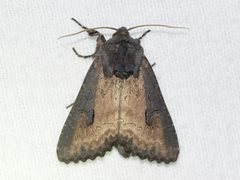
Macronoctua onusta, commonly called the iris borer, is a noctuid native to North America. are large, dull brown moths with distinctive smoky dark gray patterning and a uniquely shaped spot. The is a foodplant whose larvae bore into the rhizomes of iris plants, making it a notable pest in gardens and horticulture. Adults fly in autumn, primarily September and October.
Pronunciation
How to pronounce Macronoctua onusta: /ˌmɑk.roʊˈnɒk.tju.ə oʊˈnuː.stə/
These audio files are automatically generated. While they are not always 100% accurate, they are a good starting point.
Identification
Easily identified by large size combined with dark gray and lateral wing margins. Diagnostic features include: spot with dark outline forming straight black line below cubital , plus spike-like process extending toward base from posteromedial end; postmedial line with serrate anterior portion and straight posterior segment. Similar dark brown lack these specific reniform spot and postmedial line characteristics.
Images
Appearance
Large with forewing length 18–21 mm. Forewing broad with scalloped outer margin, dull brown base color with broad smoky dark gray suffusion on , in , terminal area, and fringe. Antemedial and postmedial lines thin, dark gray; antemedial line drawn far lateral above margin. line dark brown, strongly arched across median area below cell. Postmedial line jaggedly zigzagged anteriorly, straight from cubitus to posterior margin. Subterminal line evident only as transition from brown subterminal area to black terminal area. Terminal area a black line. Three spots outlined in thin black: spot small oval; spot large, asymmetrically kidney-shaped with lower end curved toward outer margin touching postmedial line, darker posterior outline forming straight black line below cubital vein, with spike-like process extending toward base from posteromedial end; claviform spot small elongate with rounded end. Hindwing dirty brown-gray with slightly darker discal spot and veins, scalloped terminal line, light gray fringe with brown base. and even smoky dark gray. Male broad and bead-like.
Distribution
North America; recorded from Vermont and presumably widespread across range
Seasonality
active in fall, primarily September and October
Diet
Larval stage feeds exclusively on rhizomes of Iris (Iridaceae); diet not described
Host Associations
- Iris - larval foodplantlarvae bore into rhizomes
Life Cycle
laid in fall; single female produces 150–200 eggs over several days. Larvae develop as borers in iris rhizomes. emerge in autumn.
Behavior
attracted to lights, though not strongly. Best obtained by rearing from larvae rather than collecting at lights.
Human Relevance
Pest of cultivated irises; larvae damage rhizomes through boring activity, potentially affecting plant health and ornamental value
Similar Taxa
- Similar dark brown NoctuidaeLack the diagnostic dark outline and spike from medial spot, and the distinctive postmedial line with serrate and straight posterior segments
More Details
Collection method
Forbes (1954) noted this is best obtained by rearing rather than at light traps, despite being weakly attracted to lights