
Apamea sora
Smith, 1903
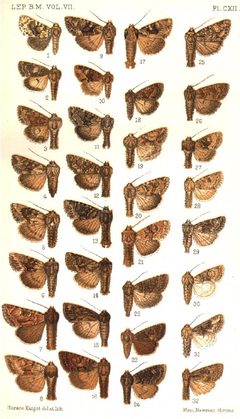
Apamea sora is a in the Noctuidae found in western North America. The exhibits considerable color variation, with forewings ranging from orange and ochre to gray, gray-violet, and black. It inhabits high-elevation spruce-fir forests and mid-elevation ponderosa pine forests of the Rocky Mountains and Pacific Northwest. The species was formerly treated as a of Apamea auranticolor but is now recognized as distinct.
Pronunciation
How to pronounce Apamea sora: /əˈpeɪmiə ˈsɔːrə/
These audio files are automatically generated. While they are not always 100% accurate, they are a good starting point.
Identification
Distinguished from similar Apamea by geographic distribution in western North America and by combination of variable forewing coloration with specific size range. Formerly considered with Apamea auranticolor, from which it was separated based on morphological and distributional evidence. Identification within the Apamea is challenging due to extensive individual variation and overlapping characteristics among species.
Images
Appearance
Forewing length 17–21 mm. Coloration highly variable: forewings appear in shades of orange, ochre, gray, gray-violet, or black. Male has bead-like . Hindwings not described in detail.
Habitat
High-elevation spruce and fir forests; mid-elevation ponderosa pine forests. Associated with mountain ranges of western North America.
Distribution
Western North America: Pacific Northwest, Alaska Panhandle, and east to Rocky Mountains of Alberta. Distribution records confirm presence in Alberta and Saskatchewan, Canada.
Life Cycle
Larva unknown; probably a (larval feeding habits inferred from placement but not confirmed by observation).
Behavior
are .
Similar Taxa
- Apamea auranticolorFormerly treated as a ; now recognized as distinct with separate geographic distribution
More Details
Taxonomic History
Formerly classified as a of Apamea auranticolor; elevated to status based on morphological and distributional evidence.
Sources and further reading
- BugGuide
- Wikipedia
- GBIF taxonomy match
- iNaturalist taxon
- Catalogue of Life
- Exciting News from the Hammock Lab | Bug Squad
- 'Mantis on a Stick' Proves Popular at Bohart Museum of Entomology Open House | Bug Squad
- Bug Eric: National Moth Week Recap for Colorado Springs
- Uncategorized | Blog - Part 12
- Burrowers playing leapfrog? A new extraordinary diamond frog from Madagascar | Blog