
Schinia villosa
Grote, 1864
Little Dark Gem
Schinia villosa, commonly known as the Little Dark Gem, is a small noctuid first described by Augustus Radcliffe Grote in 1864. It is primarily a western North American associated with montane , though its range extends eastward across the Canadian prairies. The species exhibits the typical Schinia trait of flower-visiting , with active in mid-summer and larvae feeding on Asteraceae .
Pronunciation
How to pronounce Schinia villosa: //ˈskiː.ni.ə vɪˈloʊ.sə//
These audio files are automatically generated. While they are not always 100% accurate, they are a good starting point.
Identification
Distinguished from other Schinia by its small size (wingspan ~20 mm), dark coloration implied by , and geographic distribution centered on western montane regions extending to the coast ranges. active July-August. Larval plants (Aster, Erigeron, Eucephalus ledophyllus) may aid identification where these plants occur. Similar small noctuids in the same should be examined for wing pattern and genitalia characteristics.
Images
Appearance
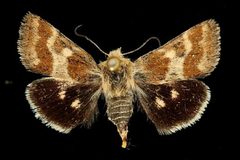
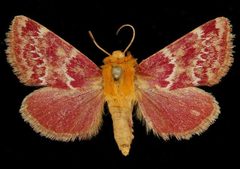
Small with wingspan approximately 20 mm. Like other members of Schinia, are typically colorful and flower-associated. Specific coloration patterns are not detailed in available sources, but the 'Little Dark Gem' suggests relatively dark, possibly iridescent or metallic coloration compared to other Schinia .
Habitat
Western montane including mountain ranges and adjacent plains. Found in environments supporting larval plants in Asteraceae, including open meadows, grasslands, and montane forest edges where Aster, Erigeron, and Eucephalus occur.
Distribution
North America: primarily western mountain from coast ranges of Washington and British Columbia south to Arizona. Range extends eastward across plains through Alberta and Saskatchewan to southern Manitoba.
Seasonality
on wing July to August, with exact timing varying by location and elevation.
Diet
Larvae feed on flowers and seed pods of Asteraceae: Aster, Erigeron, and Eucephalus ledophyllus. feeding habits not specified in sources.
Host Associations
- Aster - larval food plantflowers and seed pods consumed
- Erigeron - larval food plantflowers and seed pods consumed
- Eucephalus ledophyllus - larval food plantflowers and seed pods consumed
Life Cycle
Complete with larval stage feeding on plant flowers and seed pods. Specific details of , pupal, and stages not documented in available sources.
Behavior
are likely flower visitors based on -level characteristics documented for Schinia, though this specific has not been directly observed for S. villosa. Some Schinia are also attracted to lights at night.
Ecological Role
Larval herbivore on Asteraceae flowers and seed pods. Potential as if flower-visiting confirmed. Part of montane and prairie as prey for .
Human Relevance
No significant documented interactions. Minor potential interest to lepidopterists and naturalists studying western North American fauna.
Similar Taxa
- Other Schinia speciesApproximately 123 in North America north of Mexico share small size, flower association, and often colorful appearance. S. villosa distinguished by dark coloration, specific plants, and western montane distribution.
- Small diurnal noctuids in Heliothinae members share similar size range and some exhibit flower-visiting . Identification requires examination of wing pattern and genitalia.
More Details
Sources and further reading
- BugGuide
- Wikipedia
- GBIF taxonomy match
- iNaturalist taxon
- NCBI Taxonomy
- Catalogue of Life
- Grasshoppers of Colorado
- Grasshoppers of Colorado
- The Big 43: The California Native Plants, Plus One, Studied in UC Davis Research | Bug Squad
- Spotlighting Bumble Bee Research in the Neal Williams' Lab | Bug Squad
- Kate Frey: How to Attract Pollinators | Bug Squad
- Bug Eric: Wasp Wednesday: Not Wasp VIII