
Schinia varix
Knudson, Bordelon & Pogue, 2003
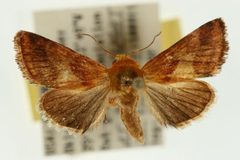
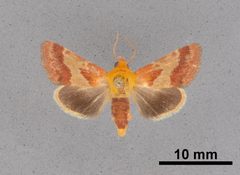
Schinia varix is a small noctuid described in 2003, notable for its striking in forewing coloration. Males display bright yellow forewings with dark purple bands, while females have darker forewings with similar patterning. The is restricted to a narrow range in the south-central United States. Despite being collected as early as 1944, its formal description was delayed for nearly six decades.
Pronunciation
How to pronounce Schinia varix: /ˈskiːniə ˈværɪks/
These audio files are automatically generated. While they are not always 100% accurate, they are a good starting point.
Identification
Distinguished from other Schinia by the combination of yellow forewings with dark purple bands in males, black hindwings with yellow fringes, and small size. The darker female forewings separate it from similar yellow Schinia species. No other Schinia in its range combines this exact pattern of purple banding on yellow ground color.
Images
Appearance
Small with forewing length of 8.6–10.2 mm. Male forewings yellow with dark purple bands in basal and subterminal areas; hindwings black with yellow fringes. Female similar but with generally darker forewings.
Habitat
Pine forests, oak-hickory woodlands, and areas with Gaillardia . Associated with sandy or gypsum-derived soils in the south-central United States.
Distribution
to south-central United States: eastern Texas, central Oklahoma, and Louisiana.
Seasonality
period from August to early October.
Host Associations
- Gaillardia - probable larval Inferred from and distribution; larvae have never been found
- Pinus - feeding site observed feeding on various pines in 1944 collections
- Ilex glabra - feeding site observed feeding on gallberry in Louisiana
- Quercus - feeding site observed feeding on oak in Oklahoma
- Carya - feeding site observed feeding on hickory in Oklahoma
Behavior
fly at night and have been observed feeding on various woody plants. Adults rest on flowers during the day, where their coloration may provide camouflage.
Ecological Role
Probable of Gaillardia and other flowering plants in its . feeding on diverse plant suggests opportunistic nectar feeding.
Human Relevance
Of interest to lepidopterists due to its restricted range, colorful appearance, and relatively recent description. The 1944 type series was collected by lepidopterists but remained undescribed until 2003.
Similar Taxa
- Other Schinia speciesMany Schinia share flower-visiting and colorful patterning, but S. varix is distinguished by its specific combination of yellow/purple forewings, black hindwings with yellow fringes, and small size restricted to the south-central US range.
More Details
Taxonomic history
First collected in 1944 in eastern Texas but not formally described until 2003 by Knudson, Bordelon & Pogue. The long delay between collection and description is unusual for such a distinctive .
Larval biology
Completely unknown. No larvae have ever been found, and the larval plant remains speculative despite strong inference for Gaillardia based on and distribution.
Etymology
The specific epithet 'varix' refers to a dilated , likely alluding to a wing venation character visible in the .
Sources and further reading
- BugGuide
- Wikipedia
- GBIF taxonomy match
- iNaturalist taxon
- Catalogue of Life
- Bug Eric: Wasp Wednesday: Not Wasp VIII
- Catch a Glimpse of Caterpillars During National Moth Week
- Bug Eric: White Prairie Clover: An Awesome Blossom
- Bug Eric: Remembering National Moth Week 2018
- Bug Eric: October 2018
- 2013 Oklahoma Collecting Trip iReport | Beetles In The Bush