
Schinia grandimedia
Hardwick, 1996
Rockies Boneset Flower Moth
Schinia grandimedia, known as the Rockies Boneset Flower , is a small noctuid moth described by David F. Hardwick in 1996. The exhibits a highly specialized ecological relationship with its plant, feeding on Brickellia eupatorioides during its larval stage. It occurs in the south-central United States with a distribution centered on the Rocky Mountain foothills and adjacent plains. The moth has a single and is active during the summer months.
Pronunciation
How to pronounce Schinia grandimedia: /ˈʃɪniə ˌɡrændɪˈmiːdiə/
These audio files are automatically generated. While they are not always 100% accurate, they are a good starting point.
Identification
The small wingspan (26–27 mm) distinguishes S. grandimedia from larger Schinia . Definitive identification requires examination of genitalia or comparison with closely related species in the S. grandimedia species group. The species may be confused with other small Schinia that share similar plant associations with Brickellia, but dissection or detailed wing pattern analysis is necessary for reliable separation. The specific epithet 'grandimedia' refers to characteristics of the male genitalia.
Images
Appearance
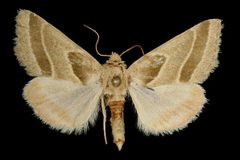
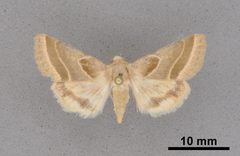
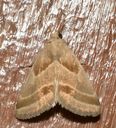
have a wingspan of 26–27 mm. The exhibits the characteristic flower- typical of the Schinia, with relatively broad forewings and compact body form. Coloration and pattern details specific to this species are not documented in available sources.
Habitat
Associated with supporting its plant Brickellia eupatorioides, which occurs in dry prairies, open woodlands, and rocky slopes. The inhabits regions where this boneset grows, typically in well-drained soils of the southern Great Plains and Rocky Mountain foothills.
Distribution
United States: Kansas south to Texas, west to Colorado and New Mexico. The distribution corresponds to the range of its primary plant.
Seasonality
One per year. period occurs during summer months, with peak activity likely corresponding to the flowering period of Brickellia eupatorioides (June–August based on regional ).
Diet
Larvae feed on Brickellia eupatorioides var. corymbulosa and var. chlorolepis (Asteraceae). feeding habits are not documented but are presumed to include nectar from flowers of the plant and possibly other available floral resources.
Host Associations
- Brickellia eupatorioides var. corymbulosa - larval food plantDocumented larval
- Brickellia eupatorioides var. chlorolepis - larval food plantDocumented larval
Life Cycle
(one per year). Larval development occurs on Brickellia eupatorioides. presumably occurs in soil or leaf litter, though specific details are not documented. emerge in summer to mate and oviposit on plant flowers or developing seed .
Behavior
are likely or flower visitors, as is characteristic of the Schinia. Larvae feed on flowers and developing seeds of the plant. Specific behavioral details such as mating systems or patterns are not documented.
Ecological Role
As a herbivore, the larvae function as seed on Brickellia eupatorioides, potentially influencing plant reproductive success in local . The stage may contribute to pollination of the plant and other co-blooming . The species represents a component of prairie and foothill biodiversity.
Human Relevance
No documented economic or agricultural significance. Of interest to lepidopterists and conservation biologists studying herbivore-plant relationships and prairie biodiversity.
Similar Taxa
- Schinia jaguarinaAnother Schinia associated with Dalea plants; differs in host specificity and likely wing pattern
- Other Schinia speciesMany Schinia are small, flower-associated noctuids with similar ; definitive separation requires genitalia examination or plant association
More Details
Etymology
The specific epithet 'grandimedia' refers to characteristics of the male genitalia, specifically the (Hardwick, 1996).
Taxonomic History
Described as a new by David F. Hardwick in 1996, based on specimens from the south-central United States. The species belongs to a complex of Schinia specialized on Asteraceae plants.
Sources and further reading
- BugGuide
- Wikipedia
- GBIF taxonomy match
- iNaturalist taxon
- Catalogue of Life
- Bug Eric: Wasp Wednesday: Not Wasp VIII
- Catch a Glimpse of Caterpillars During National Moth Week
- Bug Eric: White Prairie Clover: An Awesome Blossom
- Bug Eric: Remembering National Moth Week 2018
- Bug Eric: October 2018
- 2013 Oklahoma Collecting Trip iReport | Beetles In The Bush