
Schinia gaurae
Smith, J.E., 1797
Clouded Crimson Moth, Clouded Crimson
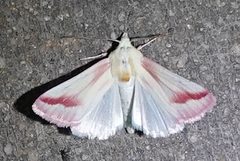
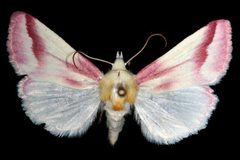
Schinia gaurae, the clouded crimson , is a Noctuidae moth described by James Edward Smith in 1797. It is widely distributed across North America from the Great Plains to the southwestern United States and Mexico. The species exhibits or depending on latitude, with larvae specializing on Gaura species. are notable for their distinctive crimson and white coloration.
Pronunciation
How to pronounce Schinia gaurae: //ˈskɪniə ˈɡaʊˌri//
These audio files are automatically generated. While they are not always 100% accurate, they are a good starting point.
Identification
Distinguished from other Schinia by the combination of crimson ground color with white clouding on the forewings, and the specific association with Gaura plants. Schinia bimatris has more distinctly bicolored forewings with sharper pattern boundaries. Schinia florida is generally smaller with more uniform coloration. Examination of genitalia may be required for definitive identification where ranges overlap.
Images
Appearance
have a wingspan of 30–32 mm. Forewings are crimson to rose-pink with variable white clouding or mottling, particularly toward the outer margins. Hindwings are typically paler, often whitish to pale pink. The body is robust and densely scaled, matching the general forewing coloration. are and relatively short.
Habitat
Open including prairies, meadows, roadsides, and disturbed areas where Gaura occur. Found from low elevations in the southern range to montane grasslands in the north.
Distribution
North America: Illinois west across southern Saskatchewan and Alberta, south to Florida, Texas, Arizona, and into Mexico. Present in Canadian provinces of Alberta, Saskatchewan, and Manitoba.
Seasonality
are active from June to August, with timing varying by location. One per year in northern portions of the range; two generations in Missouri and presumably other southern areas.
Diet
Larvae feed exclusively on of Gaura (Onagraceae). feeding habits are not documented.
Host Associations
- Gaura - larval plantLarvae feed on Gaura . Specific species not documented in available sources.
Life Cycle
Complete with , larva, pupa, and stages. Larval development occurs on Gaura plants. presumably occurs in soil or leaf litter, though specific details are not documented. One annually in the north; two generations in the south.
Behavior
are and attracted to light. Larvae are presumably solitary feeders on plant foliage and flowers.
Ecological Role
Larval herbivore on Gaura . Presumed as , though this has not been documented. Serves as prey for including birds and other arthropods.
Human Relevance
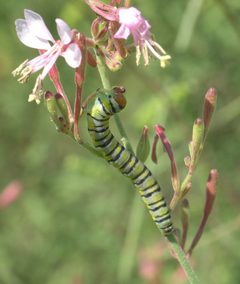
Occasionally encountered by naturalists and enthusiasts. Caterpillars noted as visually striking. No economic significance.
Similar Taxa
- Schinia bimatrisSimilar size and coloration, but forewing pattern has more sharply defined bicolored appearance with less diffuse white clouding
- Schinia floridaSmaller size and more uniform crimson coloration without prominent white markings
More Details
Larval Appearance
Caterpillars are strikingly colored with longitudinal stripes and are found on stems of Oenothera glaucifolia (false gaura) as well as true Gaura