
Schinia ferrisi
Pogue & Harp, 2004
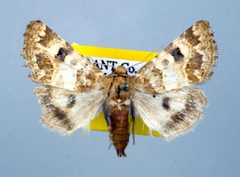
Schinia ferrisi is a noctuid described in 2004 by Pogue and Harp. The is known from a restricted range in the southwestern United States, specifically southeastern Arizona and southwestern New Mexico. are active in September. As a member of the Schinia, it likely shares the group's characteristic association with specific plants for larval development, though direct observations of this species' remain limited.
Pronunciation
How to pronounce Schinia ferrisi: //ˈskiːniə ˈfɛrɪsi//
These audio files are automatically generated. While they are not always 100% accurate, they are a good starting point.
Identification
No specific diagnostic features distinguishing Schinia ferrisi from are documented in available sources. The Schinia contains over 120 North American , many of which are brightly colored and patterned. Species-level identification within Schinia typically requires examination of genitalia and other microscopic characters.
Images
Distribution
Southeastern Arizona and southwestern New Mexico, United States.
Seasonality
are on wing in September.
Similar Taxa
- Other Schinia speciesThe Schinia contains over 120 North American , many with similar size, coloration, and flower-visiting . Microscopic examination is typically required for reliable differentiation.
More Details
Taxonomic history
Described as a new by Pogue and Harp in 2004, indicating relatively recent recognition in scientific literature.
Data availability
With only 27 observations recorded on iNaturalist as of the knowledge cutoff, this remains poorly documented in citizen science databases.
Sources and further reading
- BugGuide
- Wikipedia
- GBIF taxonomy match
- iNaturalist taxon
- NCBI Taxonomy
- Catalogue of Life
- Encyrtid Holdings | Entomology Research Museum
- Bug Eric: Wasp Wednesday: Not Wasp VIII
- Catch a Glimpse of Caterpillars During National Moth Week
- Bug Eric: White Prairie Clover: An Awesome Blossom
- Bug Eric: Remembering National Moth Week 2018
- Green Light: New ID Test Ready for Invasive Mealybug Pest