
Schinia bina
Guenée, 1852
bina flower moth
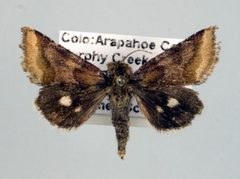
Schinia bina is a small noctuid with a wingspan of approximately 11 mm. The occurs across a broad North American range from Mexico City northward to central Florida and into the Canadian prairies. are active in summer with a single . Larvae are specialized feeders on flowers and developing seeds of specific plants in the Asteraceae .
Pronunciation
How to pronounce Schinia bina: //ˈskɪniə ˈbaɪnə//
These audio files are automatically generated. While they are not always 100% accurate, they are a good starting point.
Identification
The extremely small wingspan (approximately 11 mm) distinguishes this from most other Schinia. Within its , identification to species level requires examination of genitalia or reference to specialized literature; external alone is insufficient for reliable determination. The combination of small size, geographic range, and association with specific Asteraceae plants provides supporting evidence for identification.
Images
Habitat
Associated with open supporting its larval plants, including prairie and grassland where Verbesina encelioides and Gaillardia pulchella occur. Specific microhabitat preferences for are not documented.
Distribution
Transcontinental North American range extending from Mexico City through the central United States to central Florida, with northern limits in the Canadian prairie provinces of Saskatchewan and Manitoba. GBIF records confirm presence in Manitoba and Saskatchewan, Canada.
Seasonality
One per year (). activity period corresponds with summer flowering of plants, though specific months are not documented in available sources.
Diet
Larvae feed on flowers and developing seeds of Verbesina encelioides (cowpen daisy), Gaillardia pulchella (Indian blanket), and hawkweed (Hieracium). feeding habits are not documented.
Host Associations
- Verbesina encelioides - larval food plantflowers and seed pods
- Gaillardia pulchella - larval food plantflowers and seed pods
- Hieracium - larval food planthawkweed ; flowers and seed pods
Life Cycle
Complete with one annually. Larvae feed on plant flowers and seed pods. details and stage are not documented. Specific timing of developmental stages is not available.
Behavior
have been observed visiting flowers. Many Schinia are or , but specific activity patterns for S. bina are not documented. Larvae feed within flower of plants.
Ecological Role
Larval herbivore on Asteraceae flowers and seeds. Potential as . Specific functions are not documented.
Human Relevance
No documented economic or agricultural significance. Subject of entomological study and citizen science documentation through iNaturalist (205 observations).
Similar Taxa
- Schinia jaguarinaSimilar size and plant associations (also feeds on Asteraceae), but distinguished by different wing pattern and more southern distribution
- Other Schinia speciesMany share similar size, flower-visiting , and Asteraceae associations; reliable separation requires genitalia examination or molecular analysis
More Details
Taxonomic Uncertainty
Schinia meskeana is treated as a probable valid but remains a formal synonym of S. bina pending taxonomic revision. This suggests the current species concept may encompass cryptic diversity.
Data Gaps
Despite being described in 1852, basic biological information including coloration, precise period, and stages remain poorly documented in accessible literature.
Sources and further reading
- BugGuide
- Wikipedia
- GBIF taxonomy match
- iNaturalist taxon
- Catalogue of Life
- New plant challenges notion of binary sexuality | Blog
- Bug Eric: Wasp Wednesday: Not Wasp VIII
- New ant species named in recognition of gender diversity | Blog
- Catch a Glimpse of Caterpillars During National Moth Week
- Bug Eric: White Prairie Clover: An Awesome Blossom
- Top 10 new species of 2021 from Pensoft journals, Part 2