
Schinia arcigera
Guenée, 1852
Arcigera Flower Moth
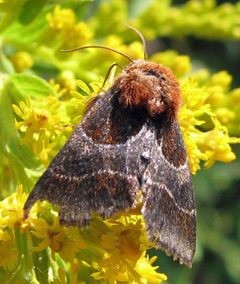
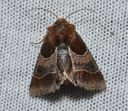
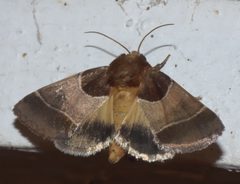
Schinia arcigera is a noctuid commonly known as the Arcigera Flower Moth. First described by Achille Guenée in 1852, this is widely distributed across North America. The moths are active during late summer and early autumn, with periods varying by latitude. The larvae are specialized feeders on several species of asters and related plants in the Asteraceae.
Pronunciation
How to pronounce Schinia arcigera: /ˈskiːniə ɑːrˈsɪdʒərə/
These audio files are automatically generated. While they are not always 100% accurate, they are a good starting point.
Identification
The can be distinguished from other Schinia by its specific wing pattern and, when necessary, examination of genitalia. The combination of size, geographic location, and association with Symphyotrichum plants aids in identification. S. a. arcigera and S. a. ferricasta differ in subtle morphological characters.
Images
Appearance
have a wingspan of 22–25 mm. The forewings display intricate patterns typical of the Schinia, with coloration and markings that provide camouflage when the rests on flowers of its plants.
Habitat
Found in open where plants grow, including meadows, prairies, and disturbed areas. The is associated with environments supporting its larval host plants in the Asteraceae .
Distribution
North America from Nova Scotia south to Florida, westward to Arizona and Idaho, and north to Saskatchewan. The spans a broad latitudinal and longitudinal range across the continent.
Seasonality
are on wing from July to September in the northeastern United States and from August to October in southern New Jersey. period extends through late summer and early autumn, with timing varying by region.
Diet
Larvae feed on flowers and developing seeds of Symphyotrichum laeve, Symphyotrichum puniceum, Symphyotrichum ericoides, and Psilactis tenuis (all Asteraceae). feeding habits are not specifically documented.
Host Associations
- Symphyotrichum laeve - larval plantsmooth blue aster
- Symphyotrichum puniceum - larval plantpurple-stemmed aster
- Symphyotrichum ericoides - larval plantwhite heath aster
- Psilactis tenuis - larval plantslender tansyaster
Life Cycle
Complete with , larva, pupa, and stages. Larvae feed on plant flowers and seed . likely occurs in soil or leaf litter, though specific details are not documented.
Behavior
are and attracted to light. They rest on flowers of plants during the day, where their coloration provides camouflage.
Ecological Role
Larvae function as primary consumers, feeding on reproductive structures of asters. The contributes to pollination dynamics and serves as prey for various . As a specialized herbivore, it may influence seed production of plants.
Human Relevance
No significant direct economic impact. The is of interest to lepidopterists and naturalists. Its plant specificity makes it a subject for studies on plant-insect relationships.
Similar Taxa
- Other Schinia speciesMany Schinia share similar size, flower-associated , and wing patterns. Identification to often requires examination of genitalia or knowledge of plant association.
- Schinia jaguarinaOverlaps in geographic range and preference; distinguished by different wing patterns and plant associations.
More Details
Subspecies
Two are recognized: Schinia arcigera arcigera and Schinia arcigera ferricasta Smith, 1906. The latter was described from more western and differs in subtle coloration and pattern elements.
Sources and further reading
- BugGuide
- Wikipedia
- GBIF taxonomy match
- iNaturalist taxon
- NCBI Taxonomy
- Catalogue of Life
- Bug Eric: Wasp Wednesday: Not Wasp VIII
- Catch a Glimpse of Caterpillars During National Moth Week
- Bug Eric: White Prairie Clover: An Awesome Blossom
- Bug Eric: Remembering National Moth Week 2018
- Uncategorized | Blog - Part 42
- Bug Eric: October 2018