
Cucullia speyeri
Lintner, 1874
Speyer's paint, Speyer's cucullia, Speyer's hooded owlet moth
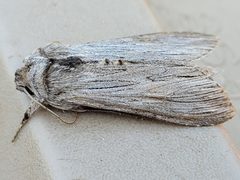
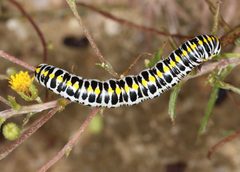
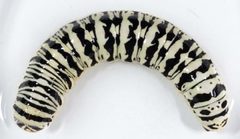
Cucullia speyeri is a noctuid found in North America, ranging from the Canadian prairies to the Atlantic coast. The species inhabits open, dry grassland and meadow . are active in late spring and summer, with a wingspan of approximately 48 mm. The larvae feed on herbaceous Asteraceae and Conyza species. In Connecticut, the species is listed as a species of special concern and is believed to be extirpated.
Pronunciation
How to pronounce Cucullia speyeri: /kʊˈkʊliːə ˈspaɪəri/
These audio files are automatically generated. While they are not always 100% accurate, they are a good starting point.
Identification
Members of the Cucullia can be recognized by their distinctive hooded forewing shape with a convex costal margin. Within the genus, C. speyeri can be distinguished from similar North American by its specific geographic distribution and association with dry grassland and prairie . Detailed morphological distinctions from closely related such as C. asteroides or C. intermedia are not documented in available sources. Dissection of genitalia is typically required for definitive species identification in this genus.
Images
Habitat
Open meadows, dry grasslands, and native prairies. The is associated with early successional and open that support its larval plants in the Asteraceae .
Distribution
North America, from Alberta and Montana eastward across the Canadian prairies (Manitoba, Saskatchewan) to the Atlantic coast from New Hampshire to Virginia.
Seasonality
are on wing in late spring and summer. Specific period timing is not documented but likely varies across the latitudinal range of the .
Diet
Larvae feed on herbaceous Asteraceae and Conyza . feeding habits are not documented.
Host Associations
- Asteraceae - larval food plantherbaceous
- Conyza - larval food plant
Life Cycle
Females deposit on or near plants. Larvae feed on Asteraceae and Conyza . likely occurs in soil or leaf litter, though specific details are not documented. emerge in late spring and summer. The species has one per year (), typical for temperate noctuids with this .
Behavior
are and likely attracted to light. Specific behavioral observations are not documented in available sources.
Ecological Role
Larval herbivore on Asteraceae. Specific ecological interactions or functions are not documented.
Human Relevance
Listed as a of special concern in Connecticut, where it is believed to be extirpated. The species has no documented economic importance or direct human interactions beyond conservation concern in parts of its range.
Similar Taxa
- Cucullia asteroidesSimilar hooded forewing and North American distribution; requires genitalic dissection for definitive separation
- Cucullia intermediaOverlapping geographic range and similar appearance; -level identification typically requires examination of genitalia
- Other Cucullia species-wide similarity in external necessitates careful examination for -level identification
More Details
Conservation status
In Connecticut, listed as a of special concern and believed to be extirpated. This status reflects loss and degradation of native prairie and grassland in the northeastern portion of its range.
Taxonomic history
Described by Joseph Albert Lintner in 1874. The specific epithet 'speyeri' likely honors an individual, though the namesake is not documented in available sources.
Sources and further reading
- BugGuide
- Wikipedia
- GBIF taxonomy match
- iNaturalist taxon
- NCBI Taxonomy
- Catalogue of Life
- UC Davis Seminar: 'Insect Conservation in an Uncertain Future' | Bug Squad
- The Eyes Have It: How Butterflies Navigate to Suitable Habitat
- USPS Issues Butterfly Postage Stamp
- Archive — Bug of the Week
- Eumastacidae | Beetles In The Bush