
Cucullia intermedia
Speyer, 1870
Intermediate Hooded Owlet, Dusky Hooded Owlet, Intermediate Cucullia, Goldenrod Cutworm
Cucullia intermedia is a noctuid distributed across southern Canada and the northern United States, with western extending to California and eastern populations reaching Pennsylvania. The exhibits two annually, with active from May through October. Larvae feed on leaves of trees and shrubs including birch, poplar, and willow, as well as flowers of Asteraceae such as Lactuca species.
Pronunciation
How to pronounce Cucullia intermedia: /kuˈkʊl.li.a ˌɪn.tərˈmiː.di.a/
These audio files are automatically generated. While they are not always 100% accurate, they are a good starting point.
Identification
Distinguished from similar Cucullia by combination of geographic range, wing pattern, and . Forewings relatively plain compared to some , lacking strong contrasting markings. Two- with extended period (May–October) differs from some northern Cucullia with single generation. Genitalia examination may be required for definitive separation from closely related species.
Images
Appearance
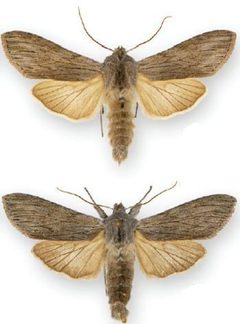
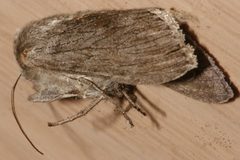
Wingspan 45–50 mm. : forewings narrow, gradually tapering; coloration dull reddish-brown to grayish-brown with variable patterning. Hindwings pale, unmarked. Body slender with characteristic 'hooded' profile typical of Cucullia, with tufted giving raised appearance. Larvae: , smooth-bodied, coloration variable but generally cryptic.
Habitat
Found in diverse including deciduous woodlands, forest edges, riparian corridors, and open areas with plants. Occurs from low elevations to montane zones in the Rocky Mountains, reaching the White Mountains of Arizona.
Distribution
Transcontinental across southern Canada (Alberta, Saskatchewan, Manitoba, Quebec, Vermont) and northern United States. Western range extends to California; eastern range reaches Pennsylvania. Rocky Mountain occur south to east-central Arizona, with common occurrence in Utah, Colorado, and northeastern Nevada.
Seasonality
on wing from May to October. Two per year throughout range; varies with latitude and elevation.
Diet
Larvae feed on leaves of birch (Betula), poplar (Populus), willow (Salix), and other trees and shrubs. Also consumes flowers of Lactuca and other Asteraceae .
Host Associations
- Betula - larval food plantleaves
- Populus - larval food plantleaves
- Salix - larval food plantleaves
- Lactuca - larval food plantflowers
Life Cycle
Two annually. Overwinters as pupa or larva (specific stage not confirmed in sources). stage duration not documented. Larval development occurs through spring and summer with two distinct cohorts. in soil or leaf litter.
Behavior
, attracted to light. Larvae are cutworms, feeding primarily at night, hiding in soil or debris during day. No migratory documented.
Ecological Role
Larval herbivore on woody plants and forbs; contributes to nutrient cycling through foliar consumption. Serves as prey for and . No specialized ecological interactions documented.
Human Relevance
Occasional minor pest on ornamental trees and shrubs. 'Goldenrod ' reflects larval feeding on goldenrod flowers, though economic impact minimal. Subject of citizen science documentation through platforms such as iNaturalist and BugGuide.
Similar Taxa
- Cucullia asteroidesSimilar size and general appearance; distinguished by forewing pattern and more northern distribution with single
- Cucullia convexipennisOverlaps in eastern range; differs in forewing maculation and larval preferences
More Details
Taxonomic History
First described by Adolph Speyer in 1870. Placed in Cucullia, characterized by hooded thoracic appearance.
Nomenclature
Multiple reflect different aspects: 'Hooded Owlet' refers to thoracic tufts; 'Goldenrod ' refers to larval feeding on Asteraceae; 'Intermediate' refers to specific epithet and possibly intermediate characteristics between related .
Sources and further reading
- BugGuide
- Wikipedia
- GBIF taxonomy match
- iNaturalist taxon
- NCBI Taxonomy
- Catalogue of Life
- Grasshopper Collections and Survey
- Hear That Buzz? Meet the Master Beekeeper | Bug Squad
- The Big 43: The California Native Plants, Plus One, Studied in UC Davis Research | Bug Squad
- Grasshoppers of Colorado
- Lewis Ocean Bay Heritage Preserve & Wildlife Management Area | Beetles In The Bush
- flatworms | Blog