
Provia argentata
Barnes & McDunnough, 1910
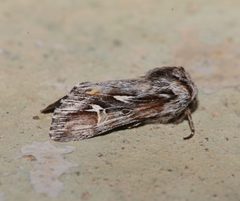
Provia argentata is a and the sole member of the Provia within the Noctuidae. It was first described in 1910 by entomologists William Barnes and James Halliday McDunnough. The species is to Utah, United States. As the only known species in its genus, it represents a unique lineage among noctuid moths.
Pronunciation
How to pronounce Provia argentata: //ˈproʊ.vi.ə ˌɑr.dʒənˈtɑː.tə//
These audio files are automatically generated. While they are not always 100% accurate, they are a good starting point.
Identification
Provia argentata can be distinguished from other noctuid by its placement in the Provia, which has no other described . The specific epithet "argentata" (silvery) suggests a characteristic silvery coloration, though detailed morphological descriptions are not readily available in the provided sources. Definitive identification relies on examination of and comparison with other Noctuinae.
Images
Distribution
to the US state of Utah. The precise locality within Utah is not specified in available sources.
More Details
Taxonomic history
The Provia and P. argentata were established simultaneously by Barnes & McDunnough in 1910, making this a relatively early 20th-century description within North American Noctuidae. The status of the genus has persisted for over a century, suggesting either genuine rarity or limited collecting effort in its Utah .
Etymology
The specific epithet "argentata" derives from Latin "argentum" (silver), likely referring to a silvery appearance of the .
Sources and further reading
- BugGuide
- Wikipedia
- GBIF taxonomy match
- iNaturalist taxon
- NCBI Taxonomy
- Catalogue of Life
- Return to Guatuso, Costa Rica: Trouble for stingless bees - the silver orb weaver, 'Argiope argentata' — Bug of the Week
- Tiger beetles in Argentina’s Chaco forest | Beetles In The Bush
- Stalking tigers in Argentina | Beetles In The Bush
- Beetle Research Roundup | Beetles In The Bush
- A non-black background is better… often! | Beetles In The Bush