
Feralia jocosa
Guenée, 1852
jocose sallow, joker moth
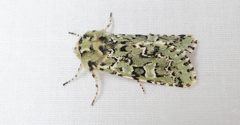
Feralia jocosa is a noctuid known as the jocose sallow or joker moth. It occurs across and temperate forests of North America from Newfoundland to coastal British Columbia, though it is replaced by the related Feralia deceptiva in the lower mainland and Vancouver Island. The is a spring flyer with a narrow wingspan of 30–32 mm. Larvae are specialized feeders on Pinus species, with documented use of Tsuga canadensis in some .
Pronunciation
How to pronounce Feralia jocosa: /fɛˈraː.li.a joˈkoː.sa/
These audio files are automatically generated. While they are not always 100% accurate, they are a good starting point.
Identification
Distinguished from Feralia deceptiva by geographic range: F. jocosa is replaced by F. deceptiva in the lower mainland and Vancouver Island of British Columbia. The two are closely related and likely require examination of genitalia or molecular methods for definitive identification where ranges approach. Spring period (April–June) helps separate from later-flying noctuids. Smaller size and early-season distinguish from many related noctuids.
Images
Appearance
Wingspan 30–32 mm. Forewings are mottled gray-brown with variable patterning typical of the . The overall coloration provides cryptic camouflage against bark and lichen. Specific diagnostic markings are not detailed in available sources.
Habitat
forest, temperate deciduous and mixed woodlands. Associated with coniferous plants, particularly Pinus . Found from sea level to elevations within the boreal zone.
Distribution
Northeastern United States south to Maryland and Ohio; north to Newfoundland; west across the forest to coastal British Columbia. Absent from the lower mainland and Vancouver Island of British Columbia, where replaced by Feralia deceptiva. Canadian provincial records include Alberta, Manitoba, and Saskatchewan.
Seasonality
fly from April to June, with timing varying by latitude and local climate. This represents a relatively early period for noctuids in its range.
Diet
Larvae feed on Pinus . Historical observations indicate larvae have also been associated with Tsuga canadensis (Eastern Hemlock), where they feed preferentially on developing staminate aments before transitioning to newly sprouted leaves.
Host Associations
- Pinus - primary larval food plant-level ; specific Pinus not documented in available sources
- Tsuga canadensis - secondary larval food plantBased on historical observations; larvae show preference for staminate aments
Life Cycle
Complete with , larval, pupal, and stages. Specific details of site, stage, and voltinism are not documented in available sources.
Behavior
. are attracted to light sources.
Ecological Role
Herbivore in coniferous and mixed forest . Larval feeding on developing reproductive structures of conifers may influence pollen production, though impacts are not quantified.
Human Relevance
No documented economic or agricultural significance. Occasionally encountered by enthusiasts at porch lights during spring period.
Similar Taxa
- Feralia deceptivaReplaces F. jocosa geographically in lower mainland and Vancouver Island of British Columbia; closely related and morphologically similar, requiring careful examination for separation
- Feralia februalisCongeneric with similar lichen-mimicking appearance, but restricted to western oak woodlands of Oregon and California; differs in larval (Quercus vs. Pinus) and geographic range
More Details
Nomenclatural history
Originally described as Diphtera jocosa by Guenée in 1852; later transferred to Feralia.
Conservation notes
Not listed as threatened. The closely related Feralia februalis is considered management-sensitive in the Pacific Northwest due to dependence on oak woodlands, but no equivalent status is documented for F. jocosa.