
Alypia wittfeldii
Edwards, H., 1883
Wittfeld's Forester
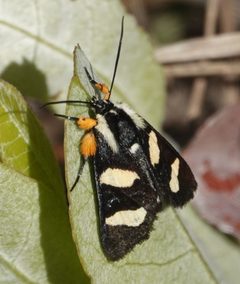
Alypia wittfeldii, commonly known as Wittfeld's Forester, is a small noctuid to the southeastern Atlantic coastal plain of the United States. First described by Henry Edwards in 1883, this is notable for its restricted distribution, occurring almost exclusively in Florida (excluding the western panhandle), coastal Georgia, and South Carolina. are active during the winter and early spring months, with forewings measuring 13–14 mm in length. The species belongs to the forester moths ( Alypia), a group characterized by bright coloration and activity patterns that contrast with the typically habits of most noctuids.
Pronunciation
How to pronounce Alypia wittfeldii: //əˈlɪpiə ˈwɪtfɛl.di.aɪ//
These audio files are automatically generated. While they are not always 100% accurate, they are a good starting point.
Identification
Can be distinguished from the related Eight-spotted Forester (Alypia octomaculata) by its more restricted geographic range and earlier period. A. octomaculata occurs more broadly across eastern North America and is active later in the year. The two may overlap in parts of their ranges, but A. wittfeldii is to the deep southeastern coastal plain. Specific wing pattern differences are not documented in available sources.
Images
Appearance
Small with forewings 13–14 mm in length. Specific coloration and pattern details are not documented in available sources, though members of the Alypia typically exhibit contrasting black and white or yellow markings on the wings.
Habitat
Coastal plain environments of the southeastern United States, including Florida peninsula, coastal Georgia, and coastal South Carolina. Specific microhabitat preferences are not documented.
Distribution
to the Atlantic coastal plain of the southeastern United States. Occurs throughout almost all of Florida except the western panhandle, along the coast of Georgia, and along the coast of South Carolina.
Seasonality
are on wing from January to April in southern Florida, with peak activity shifting to mostly April along the coasts of South Carolina and Georgia. This represents a winter–early spring period unusual for most temperate noctuid .
Similar Taxa
- Alypia octomaculataThe Eight-spotted Forester is a closely related congeneric with similar activity and bright coloration. It occurs more broadly across eastern North America and has a later period, reducing overlap in timing in most areas.
More Details
Taxonomic history
First described by Henry Edwards in 1883. The Alypia has undergone taxonomic revision, with formerly placed in separate now consolidated within Noctuidae Agaristinae.
Conservation status
No formal conservation status has been assigned. The restricted range and specific requirements may warrant monitoring, but trends are not documented.