
Alypia
Hübner, 1818
forester moths, eight-spotted forester
Species Guides
5- Alypia langtoni(Langton's Forester)
- Alypia mariposa(Mariposa Forester)
- Alypia octomaculata(Eight-spotted Forester)
- Alypia ridingsii(Ridings' Forester)
- Alypia wittfeldii(Wittfeld's Forester)
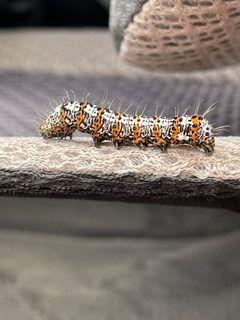
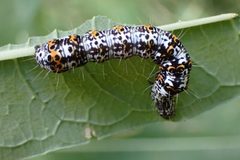
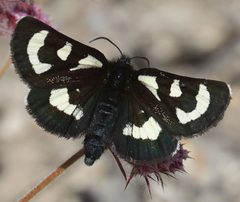
Alypia is a of in the Noctuidae, native to North America. These moths are notable for their striking coloration—generally dark to black with contrasting yellowish or white spots—and their activity, which is unusual for noctuids. The genus includes approximately five described , with A. octomaculata (eight-spotted forester) being the most familiar. Larvae feed on plants in the grape family (Vitaceae), including Virginia creeper and ampelopsis.
Pronunciation
How to pronounce Alypia: /əˈlɪpiə/
These audio files are automatically generated. While they are not always 100% accurate, they are a good starting point.
Identification
Distinguished from other small black-and-spotted by the specific arrangement of pale spots on dark wings combined with activity. A. octomaculata has exactly eight white spots. Separated from similarly patterned tiger moths (Arctiinae/Erebidae) by wing venation and structure. Distinguished from grape leaf skeletonizer (Harrisina americana, Zygaenidae) by spot pattern and lack of red collar. Larvae recognized by smooth body, distinct segmental markings, and association with grape .
Images
Habitat
Deciduous woodlands, forest edges, and areas with abundant plants in the grape . Often found near streams, roadsides, and disturbed where Virginia creeper and related vines grow.
Distribution
Native to North America. Records from United States and Canada, including Vermont. occur across eastern and central North America, with some extending into western regions.
Seasonality
active during spring and summer months, with peak activity varying by latitude. makes them conspicuous during daylight hours.
Diet
Larvae feed on leaves of plants in the grape (Vitaceae), including Virginia creeper (Parthenocissus quinquefolia), ampelopsis (Ampelopsis spp.), and cultivated grapes (Vitis spp.). have been observed nectaring at flowers.
Host Associations
- Parthenocissus quinquefolia - larval Virginia creeper
- Ampelopsis spp. - larval peppervine
- Vitis spp. - larval grapes
Life Cycle
Complete with four stages: , larva, pupa, and . Larvae are the primary feeding stage, consuming foliage of plants. occurs in soil or leaf litter. Adults are short-lived and do not feed extensively. Larval stage has been described for A. octomaculata and A. mariposa; other ' larvae remain undescribed.
Behavior
are , flying during daylight hours—unusual for Noctuidae. They are fast, darting fliers often seen visiting flowers. When at rest, wings are held in a tent-like posture over the body. Larvae feed exposed on leaf surfaces, consuming tissue between and creating a skeletonized appearance.
Ecological Role
Larvae function as herbivores on grape plants, contributing to nutrient cycling and serving as prey for and . may serve as minor when nectaring. The represents an example of aposematic coloration in a family typically associated with cryptic, .
Human Relevance
Larvae can be minor pests on cultivated grapes, though damage is rarely severe. The eight-spotted forester (A. octomaculata) is familiar to naturalists and gardeners due to its conspicuous daytime activity. Used in educational contexts to illustrate unusual traits in the Noctuidae .
Similar Taxa
- Harrisina americanagrape leaf skeletonizer; similar plants and black coloration, but has red collar and is in Zygaenidae; larvae skeletonize leaves but have different body form
- Syntomeida epilaispolka-dot wasp moth; similar black-and-spotted pattern but with blue and red markings, -like appearance, and oleander plants
- Notarctia proximaMexican tiger moth; black-and-white striped pattern but in Erebidae (formerly ), with different wing shape and habits
More Details
Taxonomic history
Alypia has been classified within Noctuidae, Agaristinae. Some sources formerly placed related colorful in separate (Ctenuchidae, ), but modern classifications consolidate these within Noctuidae or Erebidae. The exemplifies the diversity of strategies within Noctuidae, challenging the stereotype of 'basic brown moths'.
Larval knowledge gaps
Despite the containing at least five , larvae have been formally described for only two: A. octomaculata and A. mariposa. The larval stages of A. langtoni, A. ridingsii, and A. wittfeldii remain undocumented in scientific literature.
Sources and further reading
- BugGuide
- Wikipedia
- GBIF taxonomy match
- iNaturalist taxon
- NCBI Taxonomy
- Catalogue of Life
- Sphingidae | Beetles In The Bush | Page 2
- The Moth and Me | Beetles In The Bush
- Saturniidae | Beetles In The Bush | Page 2
- Noctuidae | Beetles In The Bush | Page 3
- blog carnivals | Beetles In The Bush
- ALYPIA MARIPOSA, LARVA