
Alypia octomaculata
Fabricius, 1775
Eight-spotted Forester, Eight-spotted Forester Moth
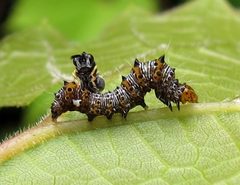
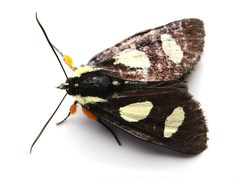
Alypia octomaculata, the eight-spotted forester, is a day-flying in the Noctuidae. are strikingly colored with black bodies and eight contrasting spots on their wings—two per wing in white, cream, or yellow shades. The is notable for its activity, unusual among noctuids, which frequently leads to misidentification as a . Larvae feed on grape family plants and are considered minor pests in vineyards.
Pronunciation
How to pronounce Alypia octomaculata: /əˌlɪpiə ˌɒktoʊˌmækjuˈleɪtə/
These audio files are automatically generated. While they are not always 100% accurate, they are a good starting point.
Identification
The combination of , black ground color, and exactly eight pale spots (two per wing) distinguishes this from other North American . Similar-looking grapevine moths such as the grapeleaf skeletonizer (Harrisina americana, Zygaenidae) have uniformly black wings with red collars rather than spotted patterns. The polka-dot wasp moth (Syntomeida epilais) has blue-based iridescent spots and red-tipped rather than cream/yellow spots.
Images
Habitat
Edges where wooded areas meet open fields; also forest clearings and areas with abundant grape vegetation. Larval specifically includes sites with grapevines, peppervines, or Virginia creeper.
Distribution
Eastern North America from Nova Scotia south to Florida, and west to Texas and South Dakota. Present throughout the eastern United States and adjacent Canadian provinces including Manitoba, Saskatchewan, and Ontario.
Seasonality
fly from April through June in northern portions of range (); two occur in warmer climates with possible third brood attempts. Peak in March for initial brood in southern regions.
Diet
Larvae feed on grape (Vitaceae) plants including grapevines (Vitis), peppervines (Ampelopsis), and Virginia creeper (Parthenocissus quinquefolia). feed on nectar from flowers of herbaceous plants, including sweetleaf (Symplocos tinctoria).
Host Associations
- Vitis - larval food plantwild and cultivated grapes
- Ampelopsis - larval food plantpeppervines
- Parthenocissus quinquefolia - larval food plantVirginia creeper
- Symplocos tinctoria - nectar sourcesweetleaf
Life Cycle
Complete with four stages. laid on plants. Larvae feed on leaves and stems, then spin soft cocoons in decaying wood, soil, or debris to pupate. Pupae can enter lasting up to four years; conditions triggering are unknown. emerge in spring, with voltinism varying by latitude.
Behavior
Active during both day and night, unusual for Noctuidae. frequently visit flowers for nectar. When threatened, larvae regurgitate an orange-tinted foul liquid as defense. Larvae escape by dropping from perches while remaining attached by silk threads. Larvae that fail to locate suitable substrate may die.
Ecological Role
Larval herbivore on native and cultivated grape plants. of spring-blooming herbaceous flowers. Serves as prey for birds and other .
Human Relevance
Larvae are considered minor pests in commercial and decorative vineyards due to leaf and stem feeding damage. are appreciated by observers due to -like appearance and habits, contributing to public engagement with diversity.
Similar Taxa
- Harrisina americanaAlso feeds on grape plants and has black coloration, but has red neck collar and lacks spotted wing pattern; belongs to different family (Zygaenidae)
- Syntomeida epilaisAnother day-flying black with spots, but has blue-iridescent spots and red abdominal tip; feeds on oleander rather than grape
Misconceptions
Frequently mistaken for a due to activity and bright coloration; this reflects a common that colorful day-flying Lepidoptera are butterflies rather than .
More Details
Diapause capability
Pupae can remain in for up to four years, an exceptionally long dormancy period among . The environmental cues triggering termination of diapause have not been determined.