
Acronicta hastulifera
(Smith, 1797)
Frosted Dagger Moth
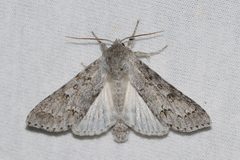
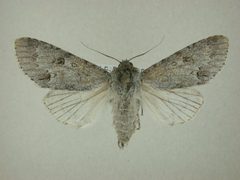
Acronicta hastulifera, commonly known as the frosted dagger , is a of owlet moth in the Noctuidae. First described by James Edward Smith in 1797, it is native to the northeastern United States with a range extending south to Georgia. The species is part of a complex that includes the large gray dagger moth, and its larvae feed on various hardwood trees.
Pronunciation
How to pronounce Acronicta hastulifera: /əˈkrɒnɪktə hæˌstjuːlɪˈfɪərə/
These audio files are automatically generated. While they are not always 100% accurate, they are a good starting point.
Images
Distribution
Northeastern United States, ranging as far south as Virginia, North Carolina, South Carolina, and Georgia
Diet
Larvae feed on alder, birch, poplar, willow, and other hardwood trees
Host Associations
- alder - larval food plant
- birch - larval food plant
- poplar - larval food plant
- willow - larval food plant
- hardwood trees - larval food plantvarious
Similar Taxa
- Acronicta betulae (Birch Dagger Moth)Similar and appearance; both are dagger moths in the same , but A. betulae is specifically associated with birch trees and has a more limited range in the eastern U.S.
- Acronicta americana (American Dagger Moth)Another dagger in the same with similar larval habits on hardwood trees, though with a broader North American distribution and distinct markings
More Details
Taxonomic Note
The is part of a referred to as "Frosted and Large Gray Daggers" on iNaturalist, indicating potential identification challenges with closely related species.
Historical Description
The was first described by James Edward Smith in 1797, originally placed in the Phalaena.