
Acronicta fallax
(Herrich-Schäffer, 1854)
Green Marvel, Green Marvel Moth
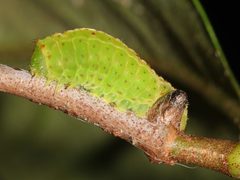
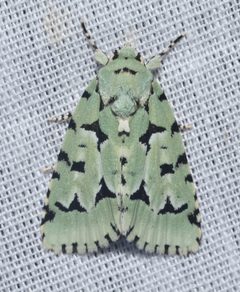
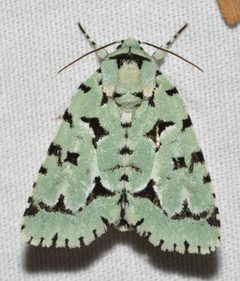
Acronicta fallax, commonly known as the green marvel , is a noctuid moth found across most of North America. First described by Herrich-Schäffer in 1854, this has a wingspan of approximately 34 mm. are active year-round in warmer regions, with particularly extended periods in Florida from February through November. The species belongs to the dagger moth Acronicta, characterized by distinctive caterpillars often bearing prominent defensive setae.
Pronunciation
How to pronounce Acronicta fallax: /əˈkrɒnɪktə ˈfælæks/
These audio files are automatically generated. While they are not always 100% accurate, they are a good starting point.
Identification
The green marvel can be distinguished from similar Acronicta by its green coloration and specific wing patterns, though detailed diagnostic features require examination of specimens. As with other dagger moths, the caterpillar stage may provide more distinctive characteristics for identification than the stage.
Images
Appearance
have a wingspan of about 34 mm. The exhibits green coloration as suggested by its , though specific pattern details are not well documented in available sources.
Habitat
Occurs in a broad range of across its extensive North American distribution, from southern Canada through the eastern and central United States to the Southwest and Florida. Specific microhabitat preferences are not well documented.
Distribution
Found across most of North America, ranging from Ontario, Quebec, New Brunswick, Nova Scotia, Newfoundland and Labrador, and Manitoba in Canada southward through the United States to Arizona in the Southwest and Florida in the Southeast.
Seasonality
are on wing from February to November in Florida, indicating a prolonged period in subtropical regions. Seasonal patterns in more northern portions of the range are less documented but likely more restricted to warmer months.
Behavior
are and attracted to light. The extended season in Florida suggests multiple or continuous breeding in favorable climates.
Similar Taxa
- Acronicta americanaSimilar dagger ; American dagger moth caterpillars are distinctive with long black setae, but differ in coloration and pattern
- Acronicta radcliffeiAnother North American dagger moth in the same with similar size and general appearance, distinguished by specific wing markings
More Details
Taxonomic History
Originally described as Moma fallax by Herrich-Schäffer in 1854, later transferred to Acronicta. The basionym Moma fallax is retained as a synonym.
Observation Data
The has over 2,000 observations on iNaturalist, indicating it is frequently encountered and well-represented in citizen science data.
Sources and further reading
- BugGuide
- Wikipedia
- GBIF taxonomy match
- iNaturalist taxon
- NCBI Taxonomy
- Meloidae Holdings | Entomology Research Museum
- Megalopygidae | Beetles In The Bush
- Honey Locust Borer | Beetles In The Bush
- Conservation Translocations: It’s Not Just Beavers - Buglife Blog - Buglife
- Bug Eric: New Mexico Dragonfly Blitz - Day 4
- Bug Eric: Remembering Moth Week 2025