
Tarache areli
(Strecker, 1898)
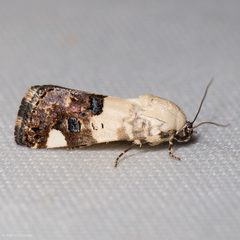
Tarache areli is a small in the Noctuidae, first described by Herman Strecker in 1898. It is distributed across western North America from British Columbia south through the western United States to Mexico. are active during summer months, with forewings measuring 10–12.5 mm in males and 10–12 mm in females. The belongs to the Acontiinae, a group of moths commonly known as bird-dropping mimics due to their camouflage coloration.
Pronunciation
How to pronounce Tarache areli: //ˈtæ.rə.ki əˈriː.li//
These audio files are automatically generated. While they are not always 100% accurate, they are a good starting point.
Identification
Distinguished from similar Tarache by geographic distribution and subtle wing pattern differences. The species was reviewed by Ferris & Lafontaine (2009) as part of the 'Acontia areli group,' which includes three newly described species. Accurate identification may require examination of genitalia or reference to the original taxonomic description.
Images
Appearance
Small with forewing length 10–12.5 mm in males, 10–12 mm in females. As a member of Acontiinae, likely exhibit cryptic coloration resembling bird droppings, a common defensive in this group. Wing patterns and exact coloration details are not well documented in available sources.
Habitat
Found in arid and semi-arid regions of western North America, including desert scrub, grasslands, and open woodlands. Specific microhabitat preferences are poorly documented.
Distribution
Western North America: Arizona, California, Colorado, Nevada, New Mexico, Texas, Utah, British Columbia (Canada), and Mexico.
Seasonality
are on wing from July to August, with exact timing varying by location and elevation.
Similar Taxa
- Tarache areloidesSimilar bird-dropping mimic appearance and overlapping distribution in southwestern North America; distinguished by subtle wing pattern differences
- Tarache delectaCongeneric in Acontiinae with similar cryptic coloration; T. delecta larvae feed on Hibiscus (mallow), but appearance similarities may cause confusion
- Other Acontiinae speciesMany members of this share bird-dropping mimic coloration, requiring careful examination for accurate identification