
Scoliopteryx libatrix
(Linnaeus, 1758)
Herald Moth, Herald
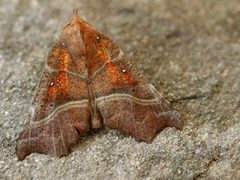
Scoliopteryx libatrix, commonly known as the herald moth, is a noctuid distributed across the Holarctic region. are notable for their distinctive wing patterning and of in caves, mines, and similar sheltered structures. The has been documented as a for fungi and shares with insectivorous bats. Its acoustic sensitivity to bat echolocation frequencies, combined with an absence of evasive responses during hibernation, represents an unusual behavioral .
Pronunciation
How to pronounce Scoliopteryx libatrix: //sko.liˈɒp.tɪ.rɪks lɪˈbeɪ.trɪks//
These audio files are automatically generated. While they are not always 100% accurate, they are a good starting point.
Images
Habitat
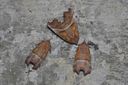
Overwinters in caves, mines, and similar sheltered structures. In the British Isles, has been recorded from caves in Devon, Norfolk, Fermanagh, and Sligo, as well as from a mine. In North America, uses cave and mine entrance areas in Ontario. Healthy typically occupy cave ceilings; infected or individuals have been observed on cave floors and rock ledges.
Distribution
Holarctic distribution: Palearctic and Nearctic regions. Documented from the British Isles (southern England, Northern Ireland, Republic of Ireland), Belgium, and North America (Ontario, Canada). GBIF records indicate presence across North America and multiple regions of Belgium.
Seasonality
overwinter in ; activity period not specified in available sources.
Host Associations
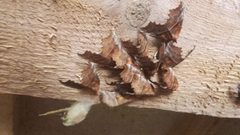
- Samsoniella scoliopterygis - fungus (Cordycipitaceae: Hypocreales) that infects , producing white or non-pigmented clavae on cadavers
Life Cycle
are the stage, seeking shelter in caves and mines during winter months. Larval stages and details not documented in available sources.
Behavior
exhibit acoustic sensitivity to ultrasound between 20–40 kHz, overlapping with bat echolocation frequencies. Tympanic organ sensitivity is 5–10 dB greater than that of other noctuid for which data are available. Notably, stationary adults show no avoidance response to ultrasonic pulses, in contrast to evasive observed in active noctuid moths. This absence of response during hibernation appears to be an to shared shelter with bats.
Ecological Role
Serves as for fungi in cave . Functions as a troglophilic or trogloxene , forming part of the cave-associated . Co-occurs with hibernating insectivorous bats, though the ecological implications of this association remain unclear.
More Details
Fungal pathology
Infected individuals are consistently found on cave floors or rock ledges rather than on ceilings with healthy , suggesting behavioral or physiological changes preceding death. The fungus produces multiple clavae in situ and synnemata .
Acoustic ecology
The combination of heightened auditory sensitivity with suppressed response represents a potential evolutionary compromise between detection and energy conservation during hibernation.
Sources and further reading
- BugGuide
- GBIF taxonomy match
- iNaturalist taxon
- NCBI Taxonomy
- Catalogue of Life
- Acoustic responsiveness of Scoliopteryx libatrix L. (Lepidoptera: Noctuidae), a moth that shares hibernacula with some insectivorous bats
- A new species of Samsoniella (Cordycipitaceae: Hypocreales) on the herald moth, Scoliopteryx libatrix (Erebidae: Noctuoidea), from caves in the British Isles